List of Eco Symbol Star Products (Hardware)
List of Eco Symbol Star Products (Software and Services)
Development of Environmentally Friendly Products
Framework for Developing Eco Products
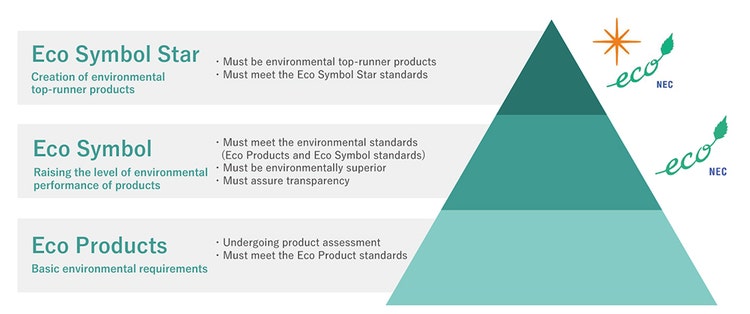
The Company places importance on environmental considerations and compliance with laws and regulations, in addition to quality, cost, and delivery, and promotes the reduction of environmental impact throughout the entire lifecycle, from procurement to use and disposal. As part of these efforts, the Company certifies and registers environmentally conscious products and software/services that meet its own environmental criteria in three tiers.
"Eco Products" are products that have been confirmed, through product assessments conducted by each business unit during new product development, to meet all of the Eco Product criteria that serve as the basic requirements.
"Eco Symbol" products are Eco Products that also meet the Eco Symbol criteria, which require a higher level of environmental performance and consideration.
"Eco Symbol Star" products are those among Eco Symbol products that meet even more stringent criteria for designation as environmental top-runner products, such as achieving a 50% reduction in CO2 emissions compared with conventional products.
Among these products and services that meet the Company's own criteria, "Eco Symbol" and "Eco Symbol Star" products display dedicated marks in product catalogs, on websites, and elsewhere to indicate that they are environmentally conscious products.
Details of Eco Symbol System and Product Assessments
List of Eco Symbol Star Products (Hardware)
List of Eco Symbol Star Products (Software and Services)
Examples of Eco Symbol Star Registrations
NEC IoT Sensor Data Visualization Service
-Making on-site information visible to support the creation of safe, reliable work environments-
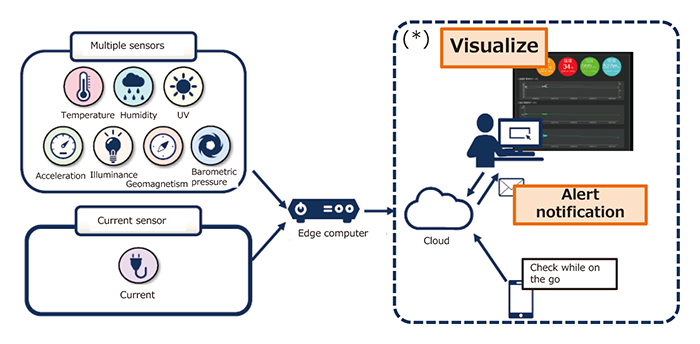
The NEC IoT Sensor Data Visualization Service is an adaptation solution that promises to mitigate risk associated with heat waves,*3 one of the risks posed by climate change according to the United Nations Intergovernmental Panel on Climate Change (IPCC). Over the past decade, the number of extremely hot days has increased, and rising temperatures due to climate change are one of the causes of heat stroke. Particularly in work environments that are prone to high temperatures and high humidity, management of workers' health is required. Until now, managers have maintained safety by periodically checking the temperature and humidity of work sites, but this takes a considerable amount of time and effort.
Our new service supports the collection of data on work environments' temperature, humidity, illumination, and air pressure. Without changing networks or other on-site environments, the service automatically collects the on-site data needed to create a safe, reliable work environment and visualizes the data through cloud computing, thereby allowing customers to receive real-time alerts remotely. By prompting appropriate measures in response to situations-such as the adjustment of temperatures and humidity at work sites or rehydration-the service's alerts are expected to prevent or reduce the risk of health hazards and illness caused by heat waves.
What is more, the collected data can be utilized to help manage work environments and improve the work efficiency of managers.
*3 A fuller description of this type of risk is the risk of death or illness due to heat waves, particularly among vulnerable groups in urban areas.
Environmental Compliance of Products
Compliance with Regulations on Chemical Substances Contained in Products
The Company is committed to appropriately complying with chemical substance regulations in Japan and overseas. In response to global regulations governing chemical substances contained in products, including the EU RoHS Directive, the EU REACH Regulation, and the U.S. TSCA, the Company is strengthening both the exchange of information on chemical substances contained in products throughout the supply chain and its internal information management systems.
For the exchange of information on chemical substances contained in products, rather than using proprietary rules, the Company commonly uses "chemSHERPA", an information communication scheme for chemical substances contained in products that complies with the international standard IEC 62474. This helps improve operational efficiency for both information providers and recipients and enables prompt responses. The Company has established a compliance framework using "chemSHERPA-CI*1" and "chemSHERPA-AI*2", which are operated by the CMP Consortium.
*1 A sheet used to provide information on chemical substances contained in substances or mixtures that is required for regulatory compliance.
*2 A sheet used to provide information on chemical substances contained in articles that is required for regulatory compliance.
Risk Management for Chemical Substances Contained in Products
Complying with the EU RoHS Directive
The EU RoHS Directive bans, in principle, the inclusion of 10 substances, including lead, mercury, and cadmium, in electrical and electronic products. The Company requests its suppliers to comply with the EU RoHS Directive in products that they supply, and conducts surveys to determine whether purchased parts and materials contain any of the banned substances. These efforts ensure that The Company branded products comply with the EU RoHS Directive, in principle.
Progress of replacement initiatives
The NEC Group has completed the substitution of all substances restricted under the "EU RoHS Directive."
For surface treatment, the transition from steel sheets treated with hexavalent chromate to trivalent chromate treatment, organic coatings, nickel plating, and stainless steel has been completed. Pigments and paints have also been switched to treatments that do not contain lead, cadmium, or hexavalent chromium.
For solder, the transition to lead-free solder has been completed.
For flame retardants, the procurement of PBDE and PBB has been prohibited since 1997, and alternative flame retardants are used. For plasticizers, the substitution of four phthalates-DEHP, BBP, DBP, and DIBP-has been completed.
For details on prohibited substances, please refer to the "Standards for Procurement Restrictions on Chemical Substances Contained in Products."
Management of exceptions
The EU RoHS Directive includes exceptions where the inclusion of prohibited substances is permitted under certain conditions. These can be used within a legally allowed period, but they must be replaced at an appropriate time.
The Company manages risks using an internal system called CHEMSIS, which centrally manages information on chemical substances contained in purchased products collected with chemSHERPA-AI, and then automatically determines whether contained substances exceed threshold values and the time limit on exemptions. At the same time, we ask suppliers to comply with the end of exemption periods six months in advance.
Confirmation by analysis
For purchased products that are deemed to be high risk, we obtain analysis data from the supplier, and when necessary, conduct our own individual analysis to confirm that prohibited substances are not contained in the products. The NEC Group has introduced fluorescent X-ray analysis systems in its production plants to create a system for confirming that certain prohibited substances, such as lead, cadmium, mercury, and hexavalent chromium, are not contained in the products.
Complying with EU REACH Regulations
The EU REACH regulations identify restricted substances that may not be included in products and Substances of Very High Concern (SVHC), which may be included but require provision of information to product recipients if they exceed a certain threshold value.
The Company uses chemSHERPA-AI to request provision of the above chemical substance information from its suppliers and manages the response information obtained centrally on its internal green procurement support system, CHEMSIS, to control the presence of restricted substances and SVHC in excess of threshold values. NEC then shares this information with sellers in the EU.
Complying with other global regulations
In addition to the EU RoHS Directive and EU REACH regulations, NEC's business divisions all work together with local subsidiaries and relevant industry organizations in Japan and abroad to comply with regulations on chemical substances contained in products applicable to each respective country, including China and the United States.
Environmental Initiatives in Supply Chains
NEC aims to reduce the environmental footprint of its products throughout their life cycles. NEC asks its suppliers to behave responsibly as corporations by the NEC Group Procurement Policy and Guidelines for Responsible Business Conduct in Supply Chains. We are working in close collaboration with our suppliers to promote green procurement.
Green Procurement
Compliance with product-related environmental regulations is an important requirement for risk management within the supply chain. The requirements for each regulation are diverse, including the restriction on the content of certain chemical substances as typified by the EU RoHS Directive, the provision of information on specified chemical substances in products based on the EU REACH Regulation, and the eco-design requirements based on the EU ESPR Regulation.
The Company positions products that comprehensively comply with these environmental laws and regulations as environmentally conscious products, and promotes the green procurement necessary to realize them. Specifically, in the Guidelines for Responsible Business Conduct in Supply Chains, we position each of items (V-1) through (V-14), stipulated as an environmental code of conduct, as the Green Procurement Standards, and request suppliers to comply with them.
Especially to comply with regulations that cover chemical substances, we ask the NEC Group's suppliers to properly manage the chemical substances contained in the products they deliver, and to cooperate in surveys for verifying the information on such chemical substances. For proper management of chemical substances in products, please also refer to the "Managing Chemical Substances Contained in Products" section.
NEC Green Procurement Standards
The Company has established the "Green Procurement Standards" to promote green procurement.
Among the "Guidelines for Responsible Business Conduct in the Supply Chain," items (V-1) through (V-14), which are defined as the environmental code of conduct, constitute the "Green Procurement Standards."
With regard to the proper management of chemical substances contained in products under the "Green Procurement Standards," detailed requirements are set out in the "Standards for Procurement Restrictions on Chemical Substances Contained in Products."
Environmental Risk Assessment Upstream in the Supply Chain
The Company conducts annual assessments of the NEC Group's suppliers to evaluate and identify risks across the entire supply chain. Through the Sustainable Procurement Self-Assessment, we confirm the status of environmental management system implementation and proper management of chemical substances. The Survey on Decarbonization and Natural Capital Initiatives reviews efforts to reduce environmental burdens such as CO2 emissions, water use and discharge, and plastic consumption. With respect to mineral procurement, we also conduct investigations that trace
back upstream in the supply chain. Details of these assessments are provided in the "Supply Chain Management (Risk Management)" section. In fiscal year 2026, we also conducted upstream risk assessments based on the concept of environmental due diligence.
Engagement Related to Climate Change
The NEC Group is strengthening collaborative initiatives with suppliers to reduce Scope 3 Category 1 emissions, which account for a significant share of the Company's total greenhouse gas emissions. Starting in fiscal year 2025, the NEC Group has identified suppliers with high CO2 emissions and significant environmental impact within its supply chain as priority engagement targets. CO2 reduction activities are being promoted in line with the steps outlined in the Guidelines for Responsible Business Conduct in Supply Chains (V-6). In fiscal year 2026, we held decarbonization
briefing sessions for management of suppliers, with 668 companies participating. We presented the NEC Green Partner Award to eight suppliers that promoted proactive initiatives related to decarbonization, and also developed a decarbonization support program for suppliers as the NEC Green Supplier Program. Under this program, we provide support mainly for SME suppliers in visualizing CO2 emissions (approximately 800 companies covered), and provide hands-on support toward obtaining SME SBT certification. As a result of activities through fiscal year 2026, four companies have obtained SBT certification, and three companies are in the process of applying (expected to obtain).
In addition, we have incorporated the continued implementation of the decarbonization support program into the NEC Eco Action Plan 2030.
Reference: NEC Stories (Supply Chain Sustainability
