NEC Product Collection Methods and Details
Governance
Resource Circulation Implementation Framework
The Company holds circular economy activity sharing meetings on a regular basis to improve synergy between circular-related businesses and create new business opportunities. Through this meeting, we share initiatives and knowledge across the Company while also promoting collaboration among businesses and linking this to the creation of new value.
Participation in Initiatives Related to Resource Circulation
- CLOMA
Participating in the "Clean Ocean Material Alliance (CLOMA)" and promoting initiatives to address the global challenge of marine plastic litter.
- Circular Partners, a government-industry-academia partnership
Working together with national and local governments, universities, companies, industry associations, and other relevant organizations that are ambitiously and proactively advancing the circular economy, to consider the measures necessary to realize a circular economy in Japan.
Strategy
In March 2025, The Company established its Circular Economy Guidelines. These guidelines address circular economy challenges such as natural resource shortages, which pose global risks on part with climate change and impacts on natural capital. They outline NEC's commitment to promoting resources circulation in its business activities and contributing to a sustainable circular economy society through technological innovation and the creation of new business models.
The Company will advance its circular economy initiatives guided by these principles.
Circular Economy Guidelines
NEC is committed to promoting resource circulation in all of its business activities, from product design and production to service provision, in response to global issue of natural resource depletion and contributes to realization of sustainable circular economy society through technological innovation and creation of new business models.
- We support realization of circular economy society by providing business models that utilize ICT and human resources to solve technical and social issues faced by entire value chain.
- We thoroughly promote resource circulation throughout our business activities and actively work to resource circulation of products we provide from design and production to use and collection.
- We actively disclose information to stakeholders in a transparent manner regarding our own initiatives for realization of circular economy society and our contribution activities for customers.
- We contribute to collaboration among stakeholders by working to create infrastructures for data distribution and sharing, which is essential for realization of circular economy society.
- We promote human resource development and awareness-raising so that each and every employee can deepen their understanding of the circular economy and actively contribute through their work.
NEC Initiatives
Collection and Recycling of Used Products
Since 1969, the Company has been collecting used IT devices such as computers from corporate customers for reuse and recycling, and since 2001, it has utilized its certification as a certified cross-regional management business operator.
In fiscal year 2026, we collected about 573 tons of computers, PCs, printers, and other IT devices from corporations, a decrease of about 18% compared with the previous fiscal year. The recycling rate1 was 98%, about the same as in the previous fiscal year. In addition, the resource-reuse rate2 as defined by the Law for the Promotion of Effective Utilization of Resources was 92%, also about the same as in the previous fiscal year. Going forward, we will promote further improvements in resource recycling through the recycling of plastics and other resources.
1 The ratio of the weight of reused, material-recycled, and thermal-recycled items to the total weight of collected IT devices
2 The ratio of the weight of materials that can be used as recycled products (parts reuse) or resources (material recycling) to the total weight of collected IT devices (as defined by the Law for the Promotion of Effective Utilization of Resources)
Used-IT-Product Collection and Recycling Rates
State of Collection and Recycling of PCs
In fiscal year 2026, The Company collected approximately 67,000 used PCs, including desktop PCs, notebook PCs, CRT displays and liquid crystal displays, an increase of approximately 20% from the previous fiscal year. We achieved the effective resource utilization rate prescribed by law (as a target to be achieved by 2003) for all of our products.
State of Collection and Recycling of PCs
Responding to the Plastic Resource Circulation Act
In 2021, prompted by the need to respond to issues such as marine plastic waste, climate change, and the tightening of waste import regulations by other countries, Japan enacted the Plastic Resource Circulation Act to further promote the domestic circulation of plastic resources. Under this law, businesses that generate industrial waste from products that use plastic (the Company is a large-volume waste generator) are required to promote the reduction and recycling of such waste. The Company aims to reduce the amount of industrial waste generated from products that use plastic and promote recycling. We have set waste reduction targets and are implementing relevant initiatives.
- Fiscal year 2027 target: Reduce waste plastic generated3 by 4.9% compared with fiscal year 2020 (per unit of sales)
- Fiscal year 2026 result: 53% reduction per unit of sales (target achieved)
- Fiscal year 2026 waste plastic generated: 599 tons
Note: Waste plastic generated and targets exclude special factors (irregular waste plastic generation associated with redevelopment of plants, etc.)
Contribution through Businesses
Construction of the Plastic Information Distribution Platform (PLA-NETJ)
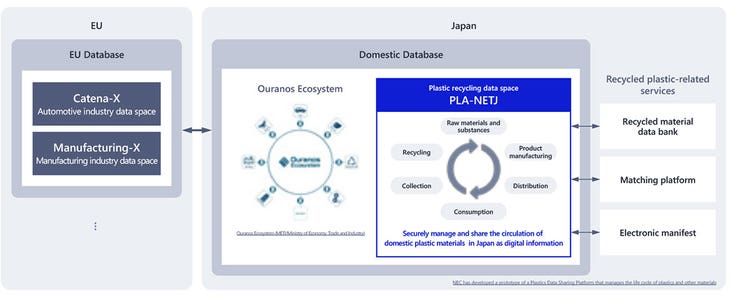
The Company is participating in the government's Strategic Innovation Promotion Program (SIP) Phase Three, focusing on the issue "Construction of a Circular Economy System," and is developing the Plastic Information Distribution Platform (PLA-NETJ).
PLA-NETJ is a digital management and information sharing system for the circulation of plastic materials used in products throughout their life cycles. In particular, we are conducting research and development with the aim of improving the use of recycled plastic materials. PLA-NETJ records trace data, such as where raw materials were mined, where they were processed, where final products were made, how much CO2 was emitted, how much recycled material is included, and information on durability. PLA-NETJ will connect to data spaces (spaces for sharing and using data across borders and fields, such as Ouranos Ecosystem, DATA-EX, and Gaia-X) developed both in and outside Japan. It will also distribute information between data registered in PLA-NETJ and data registered in other systems, and will operate as a digital product passport (DPP).
PLA-NETJ Features
Since PLA-NETJ manages data based on the material of the product, it can manage the physical properties of plastic materials, both virgin and recycled, in cooperation with the material informatics system used in material development and the recycled materials data bank developed in this SIP, and can match supply and demand as a plastic materials database. In addition, distributed management using blockchain enables the management of trace data for product life cycles. Product life cycles in physical space will be managed and visualized by PLA-NETJ in cyberspace. For the realization of a circular economy, secure information exchange between domestic and international companies is essential.
Developed an information exchange platform for the domestic plastics industry in cooperation with other companies and countries.
Advancing Recycled Plastic Production Using Materials Informatics
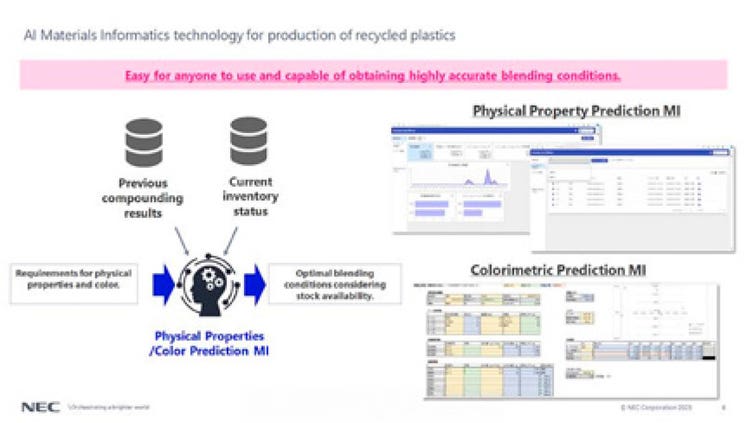
To promote resource circulation, the Company is working to advance recycled plastic production through the use of Materials Informatics (MI). In producing recycled plastics, as the types, quality, and inventory status of collected waste plastics fluctuate daily, it is necessary to optimize blending and color matching in order to meet required performance such as strength, flowability, and color, and a challenge has been the heavy reliance on the knowledge and experience of skilled workers. Accordingly, initially, together with MARUKI SANGYO Co., Ltd., we developed a system that uses blending data accumulated by MARUKI SANGYO, our materials development expertise, and MI technology to present blending and color-matching proposals in accordance with inventory status by inputting target performance and color.
In a demonstration experiment in September 2024, we confirmed that the time required for blending and color matching could be reduced by approximately 33% for skilled workers and by approximately 50% for less-experienced workers.
Furthermore, in October 2025, we began a four-company collaboration with Mitsui Chemicals, Inc., HAGIHARA INDUSTRIES INC., and MARUKI SANGYO Co., Ltd. By combining an extruder that controls the amount of additive input while measuring viscosity during the manufacturing of recycled plastics with our MI technology, we are working to transform the recycled plastic production process itself and are taking on the challenge of realizing labor savings at manufacturing sites through stabilized quality, expanded manufacturing capacity, and improved work efficiency.
Through this, we aim to eliminate the tumbling process, which has been required to stabilize quality at companies that manufacture and use recycled plastics, and aim to reduce the time required for the overall manufacturing process by 25% compared with the conventional process.
Promote the Use of Recycled Materials
From fiscal year 2027, the Company will promote the use of recycled plastics in products company-wide. This initiative is also positioned in the company-wide environmental mid-term plan, and we will advance consideration and implementation in each business and product. To date, we have advanced the use of recycled plastics and initiatives that consider resource circulation in certain products, but going forward, we will deploy these initiatives under a company-wide policy and link them to promoting resource circulation through products.
Risk Management
Specific opportunities
(economic value)
Waste with High Environmental Impact
The Company engages in the sale and manufacture of information equipment such as servers, routers, and wireless communications equipment. These products are made using a wide variety of chemical substances, and if these substances are not disposed of properly after use, they could have a major impact on the environment. Therefore, in 2001 The Company became a certified processor of industrial waste, a first for the electronics industry, and since then the Company has become committed to collecting and recycling its products. Moreover, when procuring parts necessary for the manufacture of our products, we are mindful, starting from the product design stage, of selecting parts that will be easy to recycle and will not cause environmental damage.
Proper processing of waste
In compliance with the Act on Waste Management and Public Cleaning, we store and manage waste generated at each site appropriately, select waste disposal companies that can properly dispose of the waste, and outsource the disposal to them. In addition, we conduct regular on-site audits to confirm that subcontractors are handling waste appropriately in accordance with the law. Furthermore, we hold waste seminars for employees regularly to deepen their understanding of proper waste disposal and put it into practice. Also, through our online training for all employees, which is part of our corporate-wide environmental program, we educate employees on reducing and sorting waste, and work to raise the awareness of each employee.
Indicators and Goals
Actions: Expand conversions of waste to sellable materials, enhance waste separation, reduce paper use through digitalization, reuse cushioning materials, and administer on-site checks targeting contractors to ensure that outsourced industrial waste goes through an appropriate disposal process
*1 Recycling rate:We support realization of circular economy society by providing business models that utilize ICT and human resources to solve technical and social issues faced by entire value chain.
*1 Recycling rate:We thoroughly promote resource circulation throughout our business activities and actively work to resource circulation of products we provide from design and production to use and collection.
*2 Resource-reuse rate:We actively disclose information to stakeholders in a transparent manner regarding our own initiatives for realization of circular economy society and our contribution activities for customers.
*2 Resource-reuse rate:We contribute to collaboration among stakeholders by working to create infrastructures for data distribution and sharing, which is essential for realization of circular economy society.
*2 Resource-reuse rate:We promote human resource development and awareness-raising so that each and every employee can deepen their understanding of the circular economy and actively contribute through their work.
Waste
Breakdown of Waste Generation
(Unit: thousand metric tons)