ICT as the cornerstone of observation and monitoring for predicting and forecasting climate change
A range of observation and monitoring data is required to predict and forecast complex changes in climate.
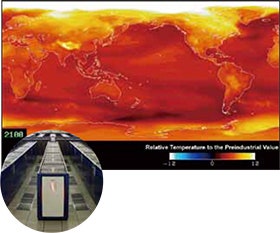
At present, we have at our disposal sensor technology that measures a variety of environmental changes over a range of locations. ICT is being utilized in every part of the process of compiling this huge quantity of data from these sensors in real time to forecast potential future events due to these changes. There are many familiar examples, including weather forecasts from data on the movement of clouds and precipitation conditions captured by meteorological satellites. The Company contributed to the development of the supercomputer, "Earth Simulator", that predicts planet-wide temperature changes up to the year 2100. It is well known that these results were utilized by the IPCC in making forecasts on climate change.
A variety of sensor technologies—the source of information collection
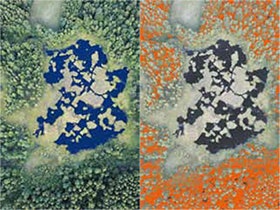
The Company provides solutions that use a variety of sensors for a diverse range of business areas, from satellites to the sea floor. For instance, with sensors equipped on satellites for global-scale observation, we are now able to see a great amount of information on the earth's water cycle, vegetation conditions and air temperature, as well as on atmospheric composition, sea surface temperature, snow precipitation and thickness of ice.
On the ground as well, sensor technology is already routinely used in familiar locations, from sensors that observe fundamental environmental data such as air temperature, water temperature, humidity and CO2 concentration, to those that measure minute vibrations, sounds, light and electric current.
Collecting sensor data to create big data
The value of data observed by sensors is heightened by looking at significance from temporal and spatial perspectives. In order to convert this data into valuable information, scattered observational data must first be collected in one place. It is here that network and cloud technologies become necessary, as does the big data technology to extract meaningful information from the enormous amount of data collected. Database software is required to accumulate with high reliability the huge volume of observation data generated with each passing moment. Further, as the volume of data being handled is very large, the capacity for high speed processing takes on great importance.
The Company possesses a series of products, software, services and technologies to collect observation data from sensors via networks, and to process large volume big data at high speeds.
The analytical technology to elicit valuable information from big data
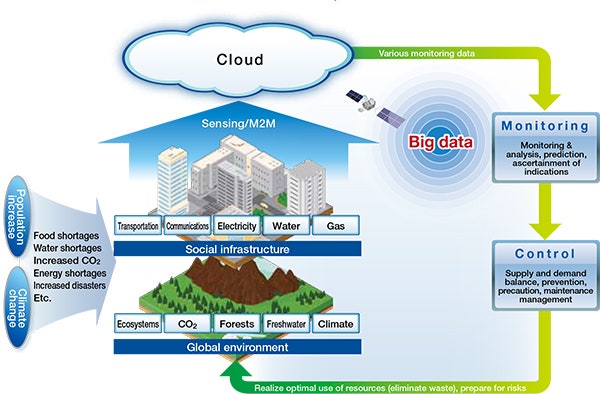
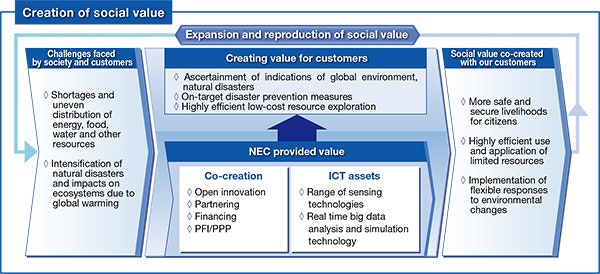
Big data will only be linked to value if it is used in proactive measures to predict and forecast future changes. However, specialized knowhow and skill is required for information analysis. The Company possesses high level skill and knowhow in information analysis, as represented by our facial recognition technology that ranks number one in the world. For instance, The Company has developed technologies and systems that effectively utilize big data. These include our invariant analysis technology, which makes highly precise predictions and carries out anomaly detection by automatically detecting multiple regularities from big data that are difficult for humans to detect, as well as our heterogeneous mixture learning technologies. By utilizing a variety of sensing data from the global environment and social infrastructure, we can respond to concerns regarding the impacts of climate change, such as disasters, water and food shortages, infrastructure breakdown, damage to health and other risks. We can provide value in preparing for risks, such as prevention and advance countermeasures, as well as enable optimal and efficient use of resources.
Frameworks for ICT-based contributions
Overall, the following four processes must be carried out to utilize ICT to respond to the risks of climate change.
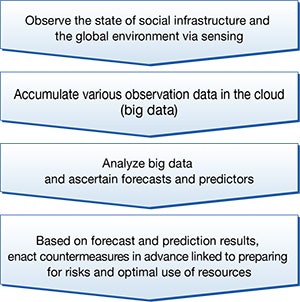
By repeating this cycle, we can realize optimal use of resources and contribute to preparing for risks.
The eight risks of climate change
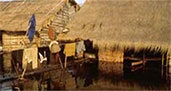
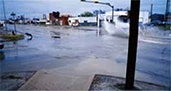




Source: Report form Working Group II: Impacts, Adaptation and Vulnerabilityin the 5th Assessment Report of the IPCC (Intergovernmental Panel of Climate Change)