Back Numbers
TNFD Report, 2nd Edition (Published 2024)
Assessing and Addressing Natural Capital (Water, Pollution, Biodiversity)Risks and Opportunities — Excerpts from the TNFD Report
According to "The Future of Nature and Business," a report published by the World Economic Forum in 2020, approximately half of the world's GDP depends on natural capital, and a report by the World Bank estimates that the collapse of ecosystem services could result in an annual economic loss of 2.7 trillion dollars. TNFD (Taskforce on Nature-related Financial Disclosures) is an important framework for correctly understanding dependencies/impacts, risks, and opportunities between the natural environment/ecosystems and corporate activities, and for incorporating them into management and investment decision-making. The NEC Group recognized its importance early and has advanced activities accordingly. We are broadening the scope of our activities through initiatives such as releasing a report ahead of the rest of the world in July 2023 and, the following year, issuing a second edition that reflects the insights we gained.
In preparing the third edition issued in August 2025, we utilized generative AI and agentic AI as an initiative unique to a technology company. Using the power of AI, we analyzed the relationship between business and the natural environment and, based on this, conducted site visits and confirmed even measures at each site and initiatives by local governments. By combining the capabilities of AI and people, we were able to achieve both efficiency and sophistication while organizing and understanding important information.
As outlined below, the Company has participated in the TNFD Forum, the Nature-related Data Catalyst, the SBT for Nature Corporate Engagement Program, and other initiatives, and has contributed to the creation of global mechanisms in the field of natural capital. The World Economic Forum has been creating industry-specific guidelines toward realizing a nature-positive economy, and our members contributed as expert committee members to the creation of the IT industry guidelines issued in December 2025. We have also incorporated the knowledge gained through that experience into this report.
Initiatives in Which the Company Participates
Nature Positive Technology Working Group
Associations: Biodiversity Working Group
1. Exploring Natural Capital Opportunities, Risks and Exposure: Led by the Natural Capital Finance Alliance and developed jointly with the United Nations Environment Programme World Conservation Monitoring Centre (UNEP-WCMC), etc. A tool for helping users understand and visualize the impacts of environmental change on the economy.
Risks (Direct Operations)
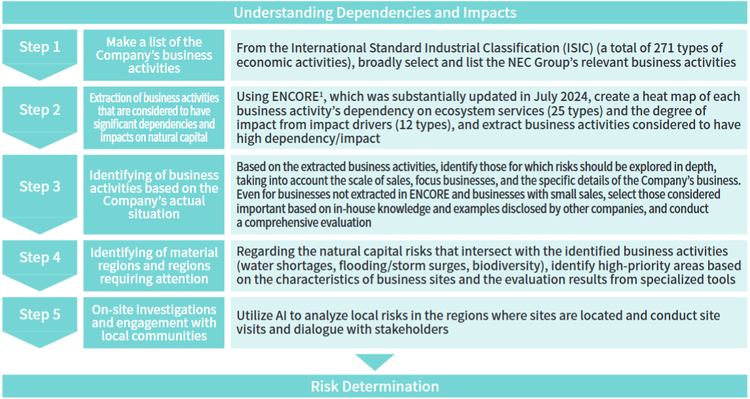
We assess and disclose the NEC Group's risks and opportunities from the perspective of natural capital. With respect to direct operational risks, we identified NEC Group business activities (55 types) and, based on the degree of potential dependency and impact on natural capital, as well as the scale and nature of the business, determined the business activities for which we will conduct a deeper analysis.
How the Risk Analysis Is Conducted
Optical Submarine Cable Business Risks and Countermeasures
In laying submarine cables, the Company takes into account the effects of weather. For example, in the North Pacific region, the weather tends to be rough during the winter season. To avoid construction during this period, NEC plans for prior permission and cable production in consultation with cable owners. In addition, by conducting oceanographic surveys, we propose routes to cable owners that avoid areas prone to undersea earthquakes and landslides, thereby increasing resilience to natural disasters.
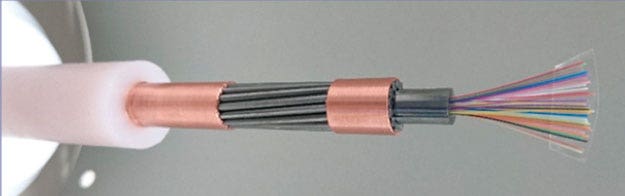
The submarine cable is as thin as 17 mm in diameter, yet strong enough to withstand 8,000 m on the seafloor. In addition, the development of multi-core fiber cables with multiple transmission paths in one fiber has enabled us to expand the transmission capacity without changing the cable thickness. This has made it possible to provide cable owners with a system that offers a higher return on investment while limiting the environmental impact.
The Company has held numerous discussions with submarine cable owners and the national and local governments where the cables are installed and complies with local laws and ordinances while laying the cables in an environmentally conscious manner. For example, in Florida, U.S.A., the cable installation was scheduled in compliance with the law so that it avoids the sea turtle spawning season. Also, depending on the environment in which the cables are to be installed, we conduct preliminary surveys of marine organisms and install silt curtains to prevent sand from being stirred up when installing the cables.
Data Center Business Risks and Countermeasures
Of the 11 sites operated by the Company in Japan, the Kanagawa Data Center and the Kobe Data Center are the ones that use air-conditioning systems that consume water in cooling towers. With respect to water shortages risk, in collaboration with the National Institute of Advanced Industrial Science and Technology (AIST), we quantitatively evaluated the level of water stress, taking into account the volume of water resources necessary for conservation of the watershed ecosystem. With respect to flood risk as well, using specialized tools, we quantitatively evaluated inundation depth in the event of a future 4°C temperature increase due to climate change.
In addition, we used AI to identify local risks including water infrastructure, and after identifying priority confirmation items, conducted site visits and dialogue with relevant stakeholders. As a result, we confirmed that the sites are connected to water sources with abundant water volumes and that there is little concern regarding water shortages. Furthermore, in addition to the redundant structure of tap water and groundwater, because we are equipped with water storage facilities capable of continuing operations for 72 hours, we have determined that the risks of operational stoppage and regional impacts are minimized. In regions with little concern regarding water shortages, using water within a sustainable range can reduce the amount of energy required for air conditioning. In addition, the NEC Eco Action Plan 2030 incorporates conducting water risk assessments in advance when constructing new sites.
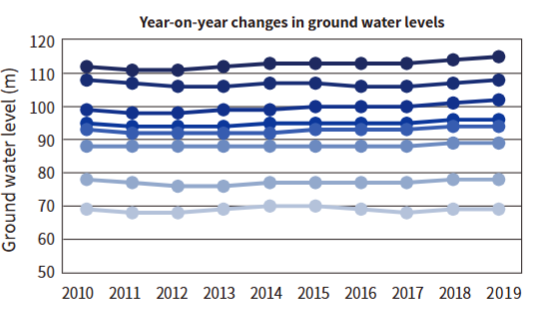
(Source: Prepared by NEC based on data from an administrative report for 2020)
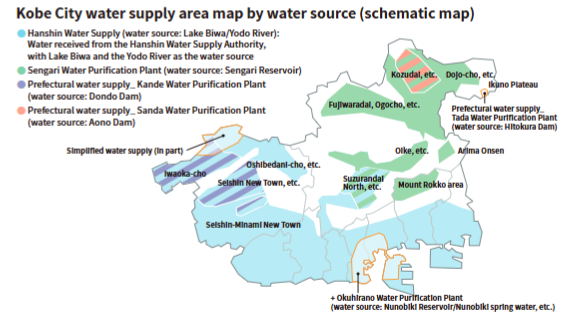
(Source: Waterworks Bureau website)
Equipment Manufacturing Business (Communications & Aerospace) Risks and Countermeasures
Waste
Soil contamination
As with the data center business, we evaluate water-related risks using high-precision specialized tools, and for biodiversity risks, we utilize IBAT (Integrated Biodiversity Assessment Tool) to multifacetedly understand the importance of ecosystems around sites. We compiled water consumption information using the Company's environmental performance management solution, GreenGlobeX.
As a result of quantitative analysis using the tools, it was found that four sites—the Pathum Thani site in Thailand, the Jiangsu site, in China, the Abiko Plant, and the Tamagawa Plant—are located in areas requiring attention; therefore, we conducted risk assessments aligned with actual conditions through on-site investigations and interviews.
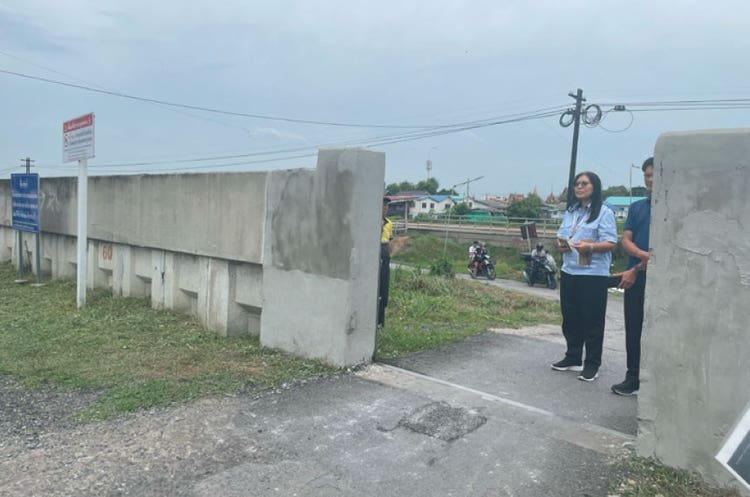
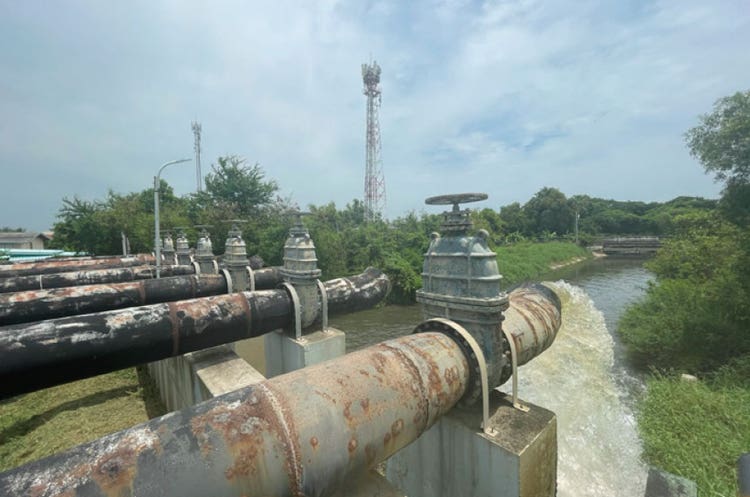
Pathum Thani Province in Thailand is an area where risks such as water shortages, flooding, and biodiversity are anticipated. With respect to water shortages risk, water is used only for air conditioning in production buildings and for cafeterias and toilets, and water scarcity will not cause production processes to stop. In addition, the site is equipped with a 400 m3 water storage tank equivalent to three days' supply, and both direct intake from the Chao Phraya River by the industrial estate and municipal water supply sourced from three upstream dams are also available.
With respect to flood risk, following the large-scale flood damage in 2011, flood BCP measures have been implemented, including installing transformers and electrical equipment at elevated locations and monitoring upstream dam water levels. Furthermore, a 2.5 m-high flood barrier has been installed over a 20 km perimeter around the industrial estate, and operation and management is carried out 24 hours a day, 365 days a year using large drainage pumps.
As a biodiversity risk, according to IBAT, birds, reptiles, and freshwater organisms categorized as Critically Endangered (CR) on the IUCN Red List have been confirmed within a 50 km radius of the site.
At existing manufacturing sites, there is no new land alteration, and impacts on surrounding biodiversity occur through wastewater, exhaust gas, and waste, etc. Our manufacturing sites are ISO 14001 certified and have established appropriate management frameworks in accordance with environmental laws and regulations. In addition, we have set voluntary standards stricter than legal requirements for exhaust gas and wastewater, and wastewater at this site is also appropriately treated at the industrial estate's treatment facility before being discharged. Based on these factors, we have determined that the biodiversity risk at this site is low.
Going forward, we will utilize the ISO 14001 environmental management system to promote the PDCA cycle of environmental management, and the NEC Eco Action Plan 2030 incorporates conducting water risk and biodiversity risk assessments in advance when constructing new sites. We have also confirmed through similar evaluations that risks are low at other sites. For details, please refer to the TNFD Report Third Edition.
Risks (Upstream Supply Chain)
Through the "Guidelines for Responsible Business Conduct in the Supply Chains," the Company requests existing and new suppliers located upstream in the value chain to undertake environmental conservation initiatives, including reducing greenhouse gas emissions, reducing water consumption, preventing air/water/soil pollution, and implementing noise countermeasures. We continuously confirm the status of compliance with the guidelines, including the status of implementation and the management framework for these environmental issues, through the "Survey on Decarbonization and Natural Capital Initiatives" conducted annually.
In this assessment, starting from the Company's representative products and referring to a general supply chain structure common to the industry, we organized the upstream tiers of the major upstream value chain, tracing back to the furthest upstream, as shown in the figure below.
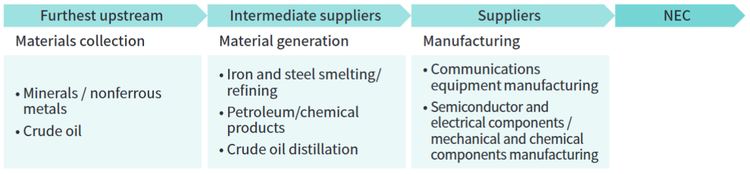
Because the ENCORE analysis results suggested dependencies and impacts on natural capital (water resources, mineral resources, biodiversity, etc.) at each layer, we evaluated dependencies and impacts by layer. Based on this, for risk assessment we adopted two different approaches for suppliers and for intermediate suppliers to the furthest upstream.
1. Response to Suppliers
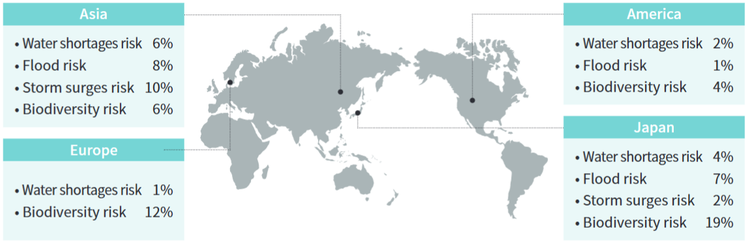
For suppliers, we selected approximately 2,000 production sites that supply hardware components assumed to have particularly large environmental impacts as the subjects of risk assessment, and conducted evaluations using high-precision specialized tools, as with our own sites. As a result, the following regional tendencies were confirmed for sites located in areas requiring attention, as shown in the figure below.
- For water-related risks, there are relatively many sites in areas requiring attention in Asian countries and within Japan.
- For biodiversity risks, there are relatively many sites in areas requiring attention in Japan and Europe.
In addition, using generative AI and agentic AI, we investigated information regarding water infrastructure and local risks for the 2,000 sites. Collecting local information for each site one by one and preparing materials to be used for dialogue with stakeholders is extremely difficult; however, through the use of generative AI and agentic AI this time, we were able to automate these tasks. This can be said to be automation equivalent to 80,000 hours of manual work.
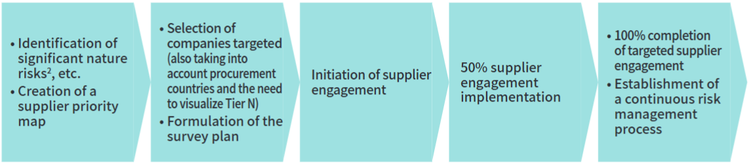
Using these results, going forward we will grasp the actual status of dependencies and impacts on natural capital at each site located in areas requiring attention and evaluate the status of responses to potential risks. To grasp the status of initiatives at each site, we will refer to the results of the "Survey on Decarbonization and Natural Capital Initiatives." For sites determined to have large dependencies and impacts on natural capital, we will work to strengthen engagement through dialogue. The NEC Eco Action Plan 2030 incorporates conducting engagement.
2. Evaluation from Intermediate Suppliers to the Furthest Upstream
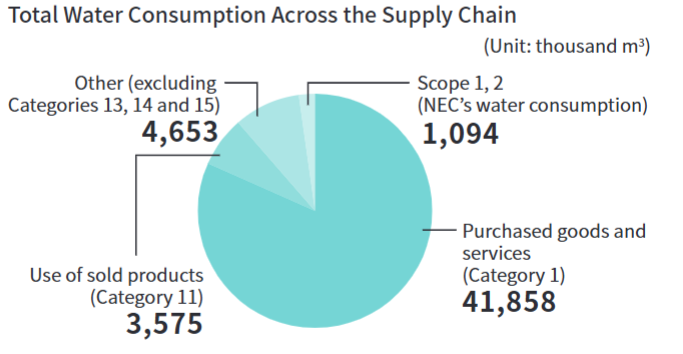
Tracing back the vast number of suppliers upstream in the supply chain to grasp the overall picture of dependencies and impacts relationships on natural capital is extremely difficult. This time, with support from the National Institute of Advanced Industrial Science and Technology (AIST), we evaluated water stress across the entire supply chain based on the same concept as Scope 3, which calculates greenhouse gas emissions on an organizational basis. As a result, we found that water consumption induced by "Purchased goods and services," which corresponds to Scope 3 Category 1,is the largest. In addition, of the total water consumption induced by the NEC Group's value chain, when aggregating the amounts of water consumption that exceed the environmental carrying capacity of each watershed, it was found to correspond to 9.7% of the total (the Japanese industrial average is 11.2%).
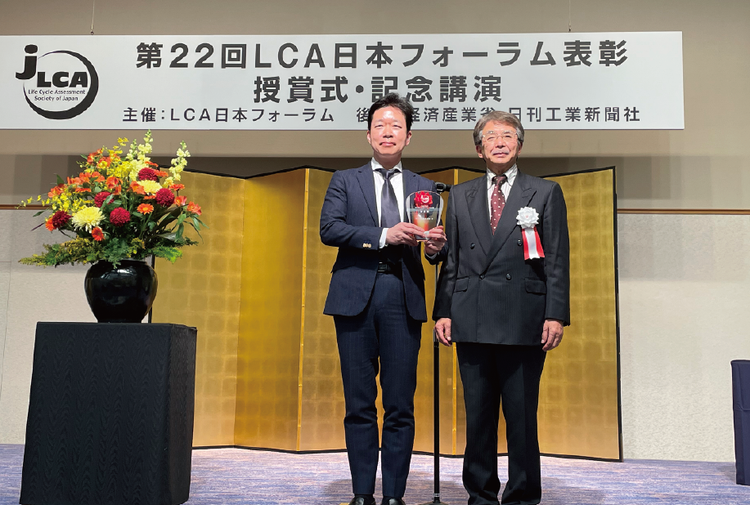
This initiative was evaluated by the LCA Society of Japan, where stakeholders from industry, academia, and national/public research institutions related to Japan's life cycle assessment (LCA) gather, and received the "LCA Society of Japan Chairman's Award" at the 22nd LCA Society of Japan Awards.
Risks (Downstream Supply Chain)
The Company is involved in collecting used equipment. Please see "Initiatives to Reduce Risk" under "Circular Economy" for details. We also rigorously manage the chemical substances contained in our products. Please see "Managing Chemical Substances Contained in Products" under "Environmental Management" for details.
2. Water shortages, flooding, biodiversity/pollution, resources
Opportunities to Contribute Through ICT Solutions
1. Incorporating Environmental Information into Business Systems — Corporate Transformation Through Decision-making Support for Operations —
To realize nature-positive management, it is important to understand the relationship between business activities and natural capital, visualize dependencies and impacts on natural capital, and incorporate risks and opportunities into decision-making for product planning, design, procurement, manufacturing, logistics, sales, and the like.
To do so, mechanisms are required to link and utilize environmental information among functional departments within companies and among companies in the supply chain. The Company believes it can contribute to such corporate transformation through ICT solutions.
On the other hand, many companies face the issue that it is difficult to use environmental information in a cross-functional manner because data formats and management methods differ among functional departments. As a result, initiatives to reduce environmental burdens are not sufficiently visualized, making it difficult for them to be reflected as added value of products and services.
We show the basic framework and case examples of how ICT can help address these challenges.
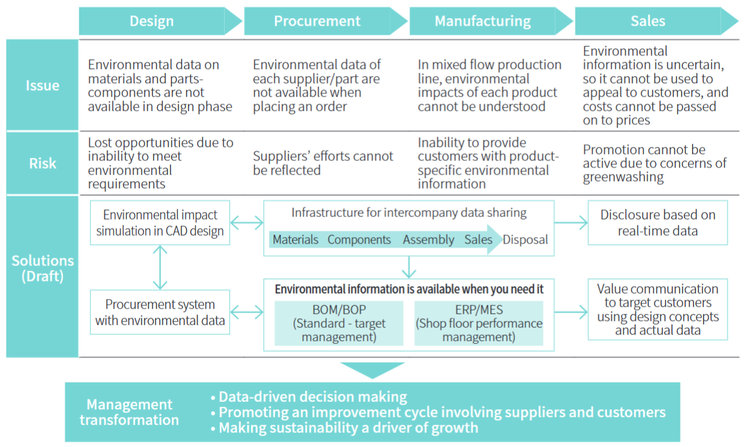
Through "NEC BluStellar," the Company supports customers in solving environmental management challenges and contributes to the transition toward a nature-positive society. NEC also engages in Thought Leadership activities, identifying key issues and proposing solutions to help shape policies and societal systems that facilitate corporate transformation.
2. Enhancing Risk/Opportunity Assessment and Disclosure Support Using AI
Leveraging the Company's in-house expertise held by the sustainability division, we provide accompaniment support services for corporate sustainability management in collaboration with the consulting division, ABeam Consulting Ltd.,a Group company, and GX Concierge Inc., a joint venture with SUMITOMO CORPORATION.
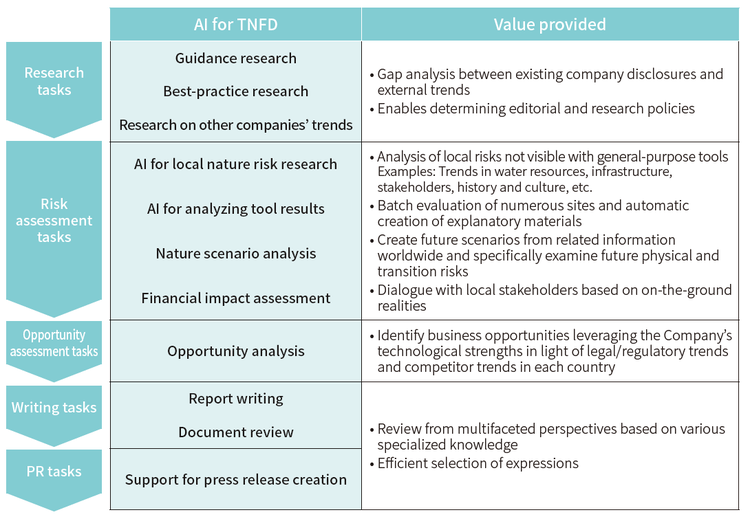
In preparing the Third Edition of the TNFD Report, by converting the expertise of personnel with specialized knowledge into explicit knowledge and utilizing generative AI and agentic AI, we significantly improved the comprehensiveness of covered sites and the depth of analysis. As shown below, we defined the tasks required for TNFD-related work and created multiple specialized AIs in order to improve AI accuracy. This is an AI solution made possible precisely because we are the Company that combines specialized knowledge of environmental management and facility management with expertise in cutting-edge AI. It can be said to be the first AI solution in and outside Japan that covers the entirety of TNFD-related work. Furthermore, we developed and evaluated agentic AI that autonomously operates these processes. We have begun using these AIs in accompaniment support services for customers.
Advancing TNFD-related Tasks Using AI
Research Tasks
We have had AI read guidance issued by various international organizations and initiatives, as well as by governments in each country. By interpreting dozens of specialized guidance documents totaling several thousand pages, we were able to conduct a gap analysis of our report and clarify areas for improvement. Work that would take at least six hours per guidance document when performed manually can now be completed in under 30 minutes.
Risk Assessment Tasks
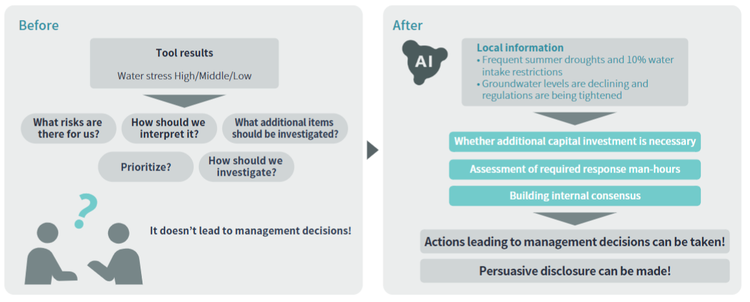
While global general-purpose tools provide high coverage, it is difficult to obtain local risk information for each region where sites are located with a level of precision that is useful for decision-making. This time, through AI we made it possible to automatically extract information such as trends in regional water resources, infrastructure, stakeholders, and history and culture. By combining this with site information (production processes, prime mover facilities, etc.), we became able to conduct risk assessments for our own and supply chain sites. As a result, whereas previously we could only conduct in-depth surveys for about three sites per year, we were able to conduct surveys of approximately 2,000 sites. This is equivalent to 80,000 hours of work. By having AI ingest specialized knowledge, risk assessments that previously could only be performed by limited members can now be performed by anyone, and by using the man-hours created by this automation, we became able to visit sites and spend time engaging in dialogue with stakeholders. In addition, by referring to information from around the world, it has become easier to conduct financial impact assessments and future scenario analyses.
Opportunity Assessment Tasks
Until now, in corporate sustainability disclosures, the introduction of solutions that contribute to environmental issues has mainly consisted of case examples. On the other hand, investors and rating agencies are seeking explanations that those examples constitute business opportunities. This time, we had AI learn the knowledge of environmental laws and regulations of each country that we have obtained over many years through legal compliance management for sites and products, and identified business opportunities based on the strengths of our technologies, solutions, and partnerships.
Going forward, the Company will continue to use technologies such as AI not only for disclosure compliance, but also as tools to minimize risks and maximize opportunities.