Governance
Water Resource Management Framework
Management System at Each Business Office and Factory
As a measure to prevent water pollution, each business office and plant sets and manages internal standards to ensure that wastewater does not exceed legal limits set by the national and local governments in each region. Our internally controlled standards are stricter than externally mandated standards. We are also working to reduce the amount of
chemical substances used during water treatment to reduce the impact of chemical trade-offs. Specifically, we prevent the input of more chemical substances than necessary by constantly monitoring water quality.
Initiatives
Water Project (Ministry of the Environment)
Participation in initiatives aimed at realizing sustainable local communities by considering the relationship between people and water and promoting the use and conservation of healthy water environments through collaboration among diverse stakeholders, including industry, government,academia, and local communities.
Water Project (Ministry of the Environment website) (Japanese language only)
Strategy
Risk Assessments and Countermeasures
Internal Water Pricing System
The Company calculates values for reductions in CO2 emissions based on its approach to internal carbon pricing to inform decisions on whether to invest in equipment, and follows a similar methodology for water. When setting prices for water, we take into account future increases in the cost of water, and assume the future unit price of water will be 2.5 times higher than it is now. We recalculate the cost impact on this basis when water usage is projected to change by at least five cubic meters per day.
Risk Management
(economic value)
Prevention of Water Pollution and Wastewater
The Company manages its wastewater with stricter standards than national and local governments to ensure their wastewater production does not exceed region-specific legal limits.
We are also working to reduce the amount of chemical substances used during water treatment to reduce the impact of chemical tradeoffs. Specifically, we prevent inputting more chemical substances than necessary by constantly monitoring water quality.
Indicators and Goals
(compared with fiscal 2019)
(compared with fiscal 2019)
(absolute values) *1
(compared with fiscal 2018)
BOD 59.2% reduction
COD 39.8% reduction
Action:Take thorough measures to expand use of recycled coolant water, operate production facilities more efficiently, and conserve water
*1 Targets BOD and COD emissions of wastewater discharged into public water areas
(However, drainage discharged from tenant offices and rainwater drainage are excluded.)
Examples of Water Usage Reduction Initiatives
Water consumption reduction initiatives
Reducing water consumption is one of the key themes of NEC's Eco Action Plan. Under this plan, we have set targets for reducing water consumption and are implementing them at all group companies worldwide. The Eco Action Plan is also covered in the annual environmental training program for all employees, which includes information on targets and initiatives related to reducing water consumption.
Reducing Water Usage by Introducing Steam Condensate Recovery Equipment
The NEC head office building uses steam for air conditioning (heating and humidification). The installation of a steam condensate recovery system (hot well tank) enables condensate generated in the steam supply process to be reused as boiler water. As a result, we were able to reduce water usage by 1,670 m3 in fiscal 2021.
In addition, NEC Sagamihara Plant is also working to reduce water usage by using the system to recover steam condensate from boilers in collaboration with other businesses located at the site.
Reducing Water Usage by Introducing a Wastewater Reuse System
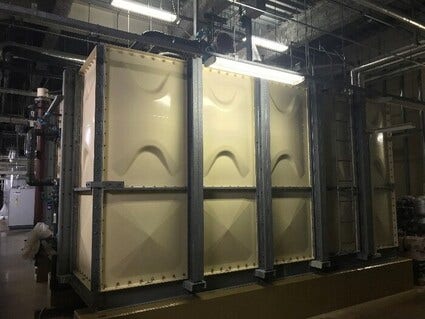
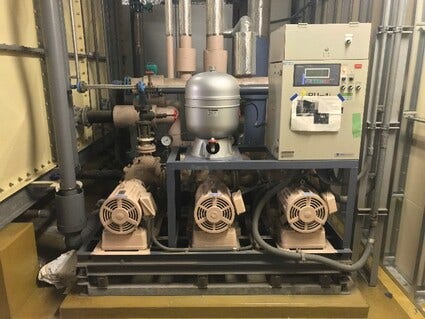
At each of the NEC Group's business sites and facilities where the system can be installed, wastewater reuse systems have been installed in restrooms, hot water supply rooms, and other areas in an effort to reduce water usage by reusing some of the wastewater in the facilities as gray water. At the NEC head office building, handwashing water in each restroom, wastewater from the hot water supply room, cooling tower blow water, and rainwater are treated using the sludge method and the activated carbon filtration method, and are reused as gray water for toilet flushing water (wastewater from toilets and urinals). At NEC Sagamihara Plant as well, a part of the cooling tower blow water is treated and reused as gray water for toilet flushing water. As a result, we were able to reduce our annual water usage by 5,650 m3 in fiscal 2021.
Reducing Water Usage by Introducing Module Chillers
At NEC Platforms' Fukushima Plant, the introduction of module chillers to cool heat source equipment in the facility has led to a reduction in the amount of cooling water used for the operation of other chillers. This has resulted in an annual reduction of 9,334 m3 of water usage in fiscal 2020.