Governance
Implementation Framework for AI and Human Rights
NEC has formulated the NEC Group AI and Human Rights Principles (the “Company-wide Principles”) in line with the NEC Group Human Rights Policy to guide employees in recognizing respect for human rights as the highest priority in its business operations in relation to social implementation of AI and utilization of biometrics and other data (“AI utilization”).
NEC Group Human Rights Policy
NEC Group AI and Human Rights Principles
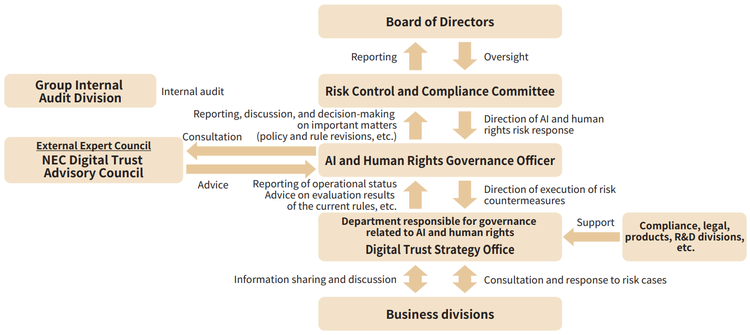
NEC incorporates initiatives based on the Company-wide Principles into corporate governance, and under the direction of the Risk Control and Compliance Committee overseen by the Board of Directors, it has established a governance framework centered on the AI and Human Rights Governance Officer and the Digital Trust Strategy Office.
As the department responsible for governance related to AI and human rights, the Digital Trust Strategy Office oversees an internal system that sets out the basic matters that corporate officers and employees must comply with to ensure respect for human rights in business activities related to AI utilization.
The Company has also established the NEC Digital Trust Advisory Council composed of external experts as an advisory framework for themes related to human rights and new technologies such as AI.
Strategy
In addition to facilitating compliance with relevant laws and regulations of each country and region, the Company-wide Principles guide employees in recognizing respect for human rights as the highest priority in each and every stage of business operations in relation to AI utilization, and enable them to take action accordingly.
In accordance with the Company-wide Principles, the Company is committed to the following three initiatives:
- Ensure that AI is utilized appropriately by NEC Group employees, customers, and partners
- Continue to develop advanced technology and talent to further promote AI utilization with respect for human rights as the highest priority
- Engage with a range of stakeholders to build partnerships and to collaborate with closely in relation to AI utilization
Risks and Opportunities Related to AI and Human Rights
The principal risks and opportunities identified by NEC as the materiality during the Mid-term Management Plan 2030 period for this theme are as follows: In addition, NEC positions this theme as one of the salient human rights issues.
“Implementing AI in society with the utmost respect for human rights (AI and Human Rights)”
1. Impact on the Environment and Society
1.1. Negative Impact
AI is unintentionally used by a third party (direct/indirect customers for the NEC Group) for surveillance, infringing citizens’ human rights.
1.2. Positive Impact
In addition to improving and enhancing operational efficiency through AI, provide safety and security to society through the use of biometrics technology.
2. Financial Risks and Opportunities
2.1. Risks
If a significant human rights violation is caused, the impact will be large.
2.2. Opportunities
As an AI Native Company, AI is a driver of growth.
Materiality during the Mid-term Management Plan 2025 period is as follows:
“Provision and Utilization of Technologies such as AI with Respect for Human Rights as the Highest Priority (AI and Human Rights)”
1. Risks
- Privacy violations accompanying new technologies
- Risks of human rights violations in the value chain
2. Opportunities
- Strengthening competitiveness
Risk Management
Risk Mitigation Initiatives
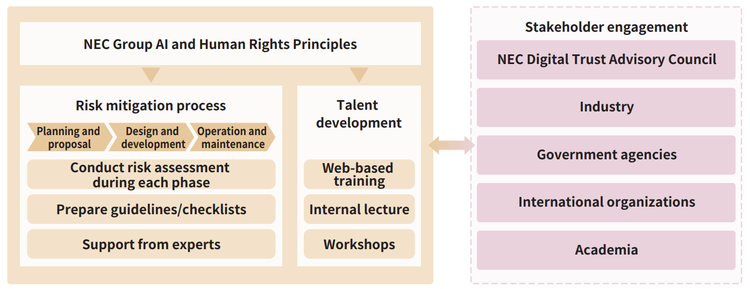
The Company understands that the social implementation of AI and the utilization of biometrics and other data can enrich people’s lives, but also recognizes that it may give rise to human rights issues such as privacy violations and discrimination depending on how it is used or if used unintentionally. Furthermore, while the expansion of AI utilization is expected to lead to business growth, there is also a possibility that it will damage the Company’s reputation or result in a decline in sales if privacy violations occur. In line with the Company-wide Principles, in the execution of business, NEC is working on a risk mitigation process, which involves identifying risks and implementing countermeasures, talent development to improve employees’ risk literacy, and stakeholder engagement to incorporate diverse external opinions into Company activities.
The Company is implementing these initiatives in accordance with Japanese and international laws, regulations, and guidelines. In particular, the Company is flexibly reviewing its internal rules and operations in response to changes in the external environment in accordance with the agile governance approach set out in the Governance Guidelines for Implementation of AI Principles announced by the Ministry of Economy, Trade and Industry in July 2021, and the AI Guidelines for Business announced by the Ministry of Internal Affairs and Communications and the Ministry of Economy, Trade and Industry in April 2024 as the successor to these. Specifically, the Company is conducting risk assessments and reviewing measures based on an understanding of trends in AI-related laws, regulations, and guidelines in Japan, the United States, Europe, and other countries, along with other issues including consumer acceptance of the use of AI.
1. Risk Mitigation Process
NEC identifies significant human rights risks arising from AI and biometric authentication technologies and concerns in the use of AI and biometric authentication technologies, and establishes company-wide rules that stipulate the governance framework and fundamental compliance issues. The Company also prepares guidelines, manuals, and risk checklists that stipulate countermeasures and operational flows. During each phase from planning to operation, the Digital Trust Strategy Office collaborates with relevant departments to implement measures according to the severity of the human rights risks posed by AI utilization. Documents and operational processes for risk responses are continuously revised to reflect the expanding use of generative AI and biometric authentication, as well as changes in relevant laws and regulations in Japan and abroad. In addition, NEC aims to promote the appropriate use of AI throughout society by providing practical know-how and insights gained through our risk mitigation initiatives to our customers and partners. These efforts include offering consulting on the development of risk mitigation processes, providing design samples for disclosing the purposes of AI use, and organizing educational workshops for customers and partners.
2. Talent Development
NEC has created definitions outlining work related to AI and human rights and clarified the required skills and proficiencies.
Furthermore, the following training is conducted for corporate officers and employees of NEC Corporation and affiliated companies in and outside Japan so that they can act appropriately with respect for human rights in business operations, in accordance with the Company-wide Principles.
Completion rate for training on AI and human rights (Data Collection)
2.1. Web-based Training
NEC provides web-based training once a year for employees, including fixed-term contract employees and temporary employees, covering basic matters including the importance of AI technology and AI ethics, trends in related laws and regulations, human rights and privacy considerations associated with AI utilization, and the Company-wide Principles and operations. (Completion rate in fiscal year 2026: 95.6%)
2.2. Internal lectures
NEC invites external experts to give lectures for persons in the Company involved in promoting the AI business. At these lectures, examples that have given rise to social criticism and other case studies are shared, and participants can learn more about points to keep in mind when providing services, and how to address them.
Materials and videos related to web-based training and internal lectures are published on the internal website, allowing employees to access the content at any time and deepen their understanding.
3. Stakeholder Engagement
NEC is collaborating and cooperating with various stakeholders to address social trends such as legal regulations and social acceptability.
3.1. NEC Digital Trust Advisory Council (External Expert Council)
To strengthen the NEC Group’s response to emerging challenges associated with AI utilization, the AI and Human Rights Governance Officer convenes the NEC Digital Trust Advisory Council. This Council engages external experts with specialized knowledge in legal systems, human rights, privacy, and ethics to provide guidance on the NEC Group’s initiatives. Since 2019, the Council has met annually, fostering continuous dialogue with its members to advance and enhance NEC’s efforts in responsible governance related to AI and human rights.
At the Council meeting in March 2026, using human-centered design and “Human-in-the-Loop,” one of the approaches for its implementation and operation, as examples, NEC sought advice on the future direction for organizing key discussion points regarding the roles and responsibilities of humans and AI. Council members shared the following insights and recommendations.
- As one of the approaches for implementing and operating human-centered design, in addition to Human-in-theLoop, in which humans review individual AI outputs on a case-by-case basis, in certain domains it may also be considered an option to adopt an approach in which humans monitor system-wide risks and performance from an overarching and holistic perspective.
- In selecting the appropriate approaches, it is important to organize by each AI utilization domain, taking into account perspectives such as the extent to which humans can accept the AI outcomes and the necessity of qualitative and moral judgment, and to examine the appropriate form of human involvement.
- While the question of what it means to be human-centered in the era of AI agents does not lend itself to an easy answer, it is important for NEC itself to continually revisit this question and engage in ongoing discussion.
Based on the insights and recommendations obtained through the Council meeting in March 2026, NEC will continue dialogue and discussion with internal and external stakeholders as NEC rethinks what it means to be human-centered in the era of AI agents.
Advisory Council Members (Japanese language only)
Implementation Report (Japanese language only)
4. Collaboration with Various Stakeholders in Japan and Abroad
4.1. Knowledge Sharing on AI, Human Rights, and Privacy
Since July 2024, NEC has joined the Keio University Global Research Institute X Dignity Center as a corporate supporter. The Center was established to explore the evolving meaning and value of “dignity” in the age of AI and to share insights with the global community. NEC continues to advance collaborative research through this partnership. In fiscal year 2026, in order to clarify the roles and responsibilities of governments and companies in AI utilization and to explore appropriate approaches to establishing rules, regulations and other governance measures depending on the nature and impact of the issues involved, NEC gained insights from external experts in various fields and engaged in discussions.
4.2. Contribution to the Formulation and Revision of the AI Guidelines for Business
NEC participated as a member of the Ministry of Internal Affairs and Communications’ Conference toward AI Network Society and its affiliated AI Governance Review Committee, and has continued to actively contribute to the formulation and subsequent revisions of the AI Guidelines for Business. These guidelines were jointly published by the Ministry of Internal Affairs and Communications and the Ministry of Economy, Trade and Industry in April 2024, with updates released in November 2024 (Version 1.01), March 2025 (Version 1.1) and March 2026 (Version 1.2).
4.3. Active Engagement in Knowledge Exchange and Collaborative Problem Solving Through Industry Associations
NEC actively engages in the activities of industry associations such as the Data Society Alliance and the AI Governance Association, contributing to cross-company knowledge exchange and collaborative discussions aimed at addressing issues related to AI risks and governance. In addition, NEC supports the development of policy proposals concerning the future direction of AI-related regulations and systems.
5. Grievance Mechanism
The NEC Customer Communication Center (CCC) has been established as a comprehensive contact point in Japan for receiving inquiries from customers regarding the Company’s products, systems, and services.
Customer Relationship Management
Metrics and Targets
FY2031 KPIs
(Scope: NEC Corporation unless otherwise specified, Period: April 2026 to March 2031)
M: Indicates the main non-financial targets related to materiality.
M: Continuous strengthening of risk management capabilities
M: Evaluation of the effectiveness of training for implementing the “NEC Group AI and Human Rights Principles”
M: Zero serious incidents
FY2027 Goals
1.1. Continuous Strengthening of Risk Management Capabilities for Emerging Risks Driven by Technological Advancement
1.2. Continued Training for Implementing the “NEC Group AI and Human Rights Principles”
1.3. Zero Serious Incidents
FY2026 Goals and Results
1. FY2026 Goals
1.1. Continue Strengthening Governance in Response to Evolving Legal and Regulatory Trends in Japan and Abroad
1.2. Continue Engaging in Dialogue with a Diverse Range of Stakeholders
1.3. Enhance Responsiveness to Emerging Risks Driven by Technological Advancement
2. FY2026 Results
2.1. Continue Strengthening Governance in Response to Evolving Legal and Regulatory Trends in Japan and Abroad
- Analyzed trends in laws, regulations, and guidelines in Japan, the United States, and Europe, shared insights with relevant internal stakeholders, and incorporated them into operations
- Provided explanations on the latest legal and regulatory trends through web-based training and internal lectures
- Analyzed trends in international laws and regulations, and based on the concept of a risk-based approach, reviewed operational processes and updated internal rules so as to enable risk responses commensurate with the risk level of each AI project
2.2. Continue Engaging in Dialogue with a Diverse Range of Stakeholders
- Continued to gain insights from experts through the NEC Digital Trust Advisory Council and incorporated them into initiatives
- Gained insights through joint research with the Keio University Global Research Institute X Dignity Center
- Contributed to knowledge exchange and collaborative problem solving through industry associations such as the Data Society Alliance and the AI Governance Association
- Leveraged the Company’s expertise to offer input and recommendations during the formulation of laws, regulations, and guidelines in Japan and abroad
- Introduced the Company’s initiatives to customers and external stakeholders
2.3. Enhance Responsiveness to Emerging Risks Driven by Technological Advancement
- Assessed potential human rights risks posed by AI agents and explored appropriate response measures
- Revised and expanded documents to address risks arising from the growing use of generative AI and biometric authentication