Governance
Framework for Human Resource Development
With a view to realizing our Human Resources (HR) Policy, we are rapidly responding to change and accelerating the establishment of systems that realize the “right person at the right job and the right time.”
1. Human Resources for Driving Transformation
We are reorganizing the roles of the Human Resources Division, which spearheads the human resource strategies that support business strategies. We have prepared a human resource model and defined the roles and responsibilities of each human resources business partner (HRBP), shared service center (SSC), and center of excellence (CoE). The CoE is responsible for formulating talent development strategies, developing systems, and creating implementation solutions; the HRBP is responsible for identifying and addressing talent development needs to optimize the talent portfolio; and the SSC is responsible for deploying and implementing talent development and training initiatives to meet these needs. Through this framework, we promote talent development that helps solve business challenges.
2. Human Resource Foundations for One NEC
To realize the HR Policy, the NEC Group must unify its human resource foundations in-house, including those in and outside Japan. Since 2019, the Company has been conducting performance development at NEC Group companies as well as at NEC Corporation, thereby enabling it to unify its human resource evaluations. Performance development encourages growth and behavioral change. It provides feedback that uses a system of nine blocks based on performance and the Code of Values, goal management, and one-on-one meetings between supervisors and their team members.
Approach
To realize the transformation of the IT business in Japan outlined in Mid-term Management Plan 2025, NEC has set a target to secure 12,000 digital transformation (DX) professionals who will continuously create and implement social value, and is strengthening efforts to develop such talent. NEC is also accelerating the growth of promising next generation leaders by offering them a variety of development opportunities such as tough assignments and training.
NEC offers a range of human resource development programs for employees, including contract employees and dispatched workers.
Our goal is to “foster professionals who align with the NEC Way and practice the Code of Values.” To achieve this, we are developing training programs and environments focused on employees’ career ownership and proactive learning, centered around the following four areas.
(1) Cultivating business leaders to compete in global markets
(2) Enhancing management talent to maximize organizational power
(3) Training professionals to realize business transformation
(4) Strengthening foundational skills and mindsets as the basis for NEC talent
NEC Way
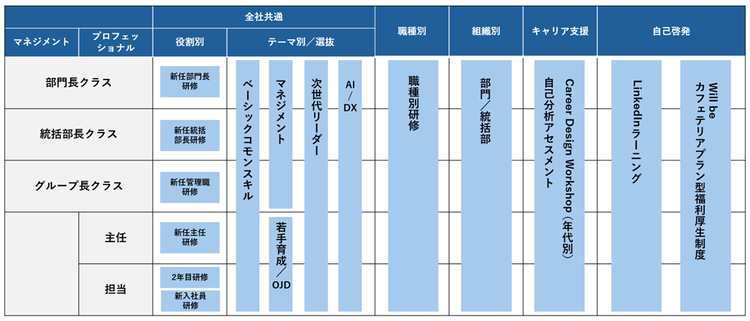
Training Framework
Details of the training framework are provided below (Japanese language only).
Training is provided to appropriate participants by domain and program, regardless of employment type.
Metrics and Targets
FY2027 Goals
1. Visualize and Strengthen the Management Talent Pipeline and Realize Strategic Placement for Sustainable Enhancement of Corporate Value
- We will actively promote the optimal placement of management leaders by linking management-critical positions with succession plans. In addition, through decision-making processes involving senior management, we will accelerate the progression from identifying next-generation management leaders to their development and appointment.
- We will identify future management leaders at an early stage and implement systematic development programs for diverse talent, including younger employees. We will also strengthen the development framework for future management leaders by expanding our data and AI infrastructure.
FY2026 Goals and Results
1. FY2026 Goals
1.1. Cultivate Leadership and Strengthen Management Capabilities to Sustain a Successful Presence in the Global Market
- Establish a shared, business-aligned standard (“next-generation leadership profile”) and link the processes of identification, development, and appointment.
- Strengthen selection and management of talent based on the next-generation leadership profile to enhance both quality and quantity of the talent pool.
- For selected members from the talent pool, have the individual, their manager, and HR jointly create Individual Development Plans (IDPs) for the member and provide tailored development support aligned with individual needs.
- Strengthen the linkage between the talent pool and succession plans, and maintain highly effective and feasible succession planning across the global Group.
2. FY2026 Results
2.1. Cultivate Leadership and Strengthen Management Capabilities to Sustain a Successful Presence in the Global Market
NEC established a next-generation leadership profile and strengthened the management leadership pipeline by linking the identification, development, and appointment processes to that profile. Through these efforts, we expanded both the quality and quantity of our next-generation management leader pool and built a foundation that enables diverse talent to thrive.
NEC deployed Individual Development Plans (IDPs) and used discussions among employees, supervisors, and human resources personnel to formulate them, support career planning, and make assignment decisions. In fiscal year 2026 in particular, the One NEC Global Leadership Program in English was conducted for 23 participants, including employees from consolidated subsidiaries outside Japan, to develop internationally competitive leaders. Furthermore, the Global Foundation Program was conducted for 18 participants to support the acquisition of fundamental management knowledge and improvement of global business communication skills.
In addition, through dispatch-style training programs at academic institutions in Japan and overseas, we supported the acquisition of advanced expertise and management perspectives. By providing opportunities for dialogue with corporate officers, we also contributed to developing talent with global perspectives and broad viewpoints.
Through these initiatives, we have strengthened the international competitiveness of next-generation management leaders and established a foundation for the organization’s sustainable growth.
- Number of digital transformation (DX) professionals as of March 31, 2026: 13,492
- Number of recommended DX certifications acquired in fiscal year 2026: 2,698
Initiatives for Human Resource Development
1. Human Resource Development Programs
The following five themes have been positioned as important themes for human resource development, and we are engaging in a variety of initiatives.
1.1. Cultivating Business Leaders to Compete in Global Markets (Next-Generation Leadership Development)
1.1.1. Talent Pool Management (Identifying Talent)
- To identify diverse talent who can become future management leaders regardless of age, nationality, or gender, approximately 1,000 diverse individuals were selected from across the NEC Group as next-generation management leaders, while also focusing on identifying younger talent.
- Of them, 111 particularly promising individuals, 25% of whom are women, were designated as “Top of Top,” with all receiving Individual Development Plans (IDPs)
- This program is deployed globally, including Japan, and has been implemented at all seven key consolidated subsidiaries outside Japan
- In fiscal year 2026, NEC reinforced this process based on the next-generation leadership profile, aiming to enhance the quality and scale of its talent pool
1.1.2. Measures for Developing Next-Generation Leaders
- For selected talent pool members, the individual, their manager, and HR work together to create an Individual Development Plan (IDP) and provide tailored development support aligned with individual needs.
- The following development options are available to meet these diverse development needs:
- The One NEC Global Leadership Program (in English) is offered to next-generation leaders aiming to achieve continued success in the global marketplace.
- Participation in dispatch-style training programs at academic institutions in and outside Japan.
- Enhancement of perspectives and support for broadening and deepening viewpoints through dialogue with corporate officers.
- Acquisition of fundamental business knowledge through online training.
- Enhancement of business English skills as needed.
- Career interviews with HR based on IDPs.
- Formation of participant networks across organizational boundaries to support learning from peers.
1.2. Enhancing Management Talent to Maximize Organizational Power
1.2.1. Enhancing the Management Skills of People Managers
To make job-based human resources management effective in the workplace, People Managers play an important role in driving business growth aligned with organizational strategy while supporting each employee’s autonomous growth.
In fiscal year 2026, NEC worked to strengthen the management capabilities of People Managers to further promote understanding of job-based human resources management in the workplace and translate that understanding into action.
- Conducted sessions to deepen understanding of the key principles of job-based human resources management and the role of People Managers and to facilitate the transition to action (approximately 2,200 participants)
- Conducted Feedback Training to maximize team performance under a job-based system (950 participants)
- Conducted the Member Career Ownership Support Workshop to acquire the mindset and skills needed to support members’ career development (approximately 800 participants)
- Conducted Director’s Cafe to facilitate exchanges among People Managers across departments and provide opportunities to gain insights through sharing issues and concerns
- Established and implemented NEC groupwide standardized programs for skills training required for the early success of newly appointed People Managers
- Leadership Program (approximately 850 participants across the NEC Group)
- Performance Management Training (approximately 1,000 participants across the NEC Group)
- Fundamentals of communication with team members (approximately 750 participants across the NEC Group)
1.3. Training Professionals to Realize Business Transformation
1.3.1. Professional Talent Development Through Job-Specific Human Resource Development Committees
In the six areas of marketing; sales and business design; services, SE, and consulting; technology development; SCM; and research and development, corporate officers of the Company representing each area serve as chairs of their respective committees. Through job-specific human resource development committees, where executives and experts selected from each organization collaborate with the human resources division, they lead the development of professional talent required for business growth. In fiscal year 2025, the first year of implementing the job-specific personnel system, we conducted a review of job roles to better align with business strategies while assessing the status of the system’s introduction by job type. In addition, we focused on strengthening specialized training required for each job type and fostering talent capable of contributing to the business. These efforts were discussed and implemented in each committee. Based on the data from the skill assessment (participation rate: 95%) conducted with the new system, we identified job-specific challenges (such as cases where skill levels did not meet expectations) and developed countermeasures in collaboration with business leaders selected from the business divisions as committee members.
1.4. Development of Personnel Conversant with DX
NEC incorporated its own unique elements into the Ministry of Economy, Trade and Industry’s framework to develop and strengthen a shared DX development framework for NEC Corporation and its consolidated subsidiaries in Japan. Over 200 specialized DX talent development programs were created and implemented, targeting foundational DX literacy (basic knowledge, mindset and culture change) and tailored to the defined roles, requirements, and development goals for DX professionals. A total of 138,037 people participated in the basic DX literacy training, and 69,797 in the specialized DX training across the Company and 16 consolidated subsidiaries in Japan.
In fiscal year 2026, DX professionals totaled 13,492 people (as of March 31, 2026). Through the issuance of digital certificates (open badges), internal publication of certified individuals by name, and dashboards showing the status of professionals by organization, NEC has achieved development aligned with business growth and the continuous development of high-level DX professionals.
Having achieved the DX talent development target of Mid-term Management Plan 2025, NEC will, from fiscal year 2027, focus on setting new priority talent and skills aligned with business strategies and on building a development framework.
Total human resources involved with DX (Data Collection)
1.5. Developing Talent in Key Focus Areas
NEC Corporation is actively engaged in training and acquiring human resources who can use its core technologies to create value.
1.5.1. Developing and Acquiring Top Researchers and Promotion of Diversity
- Introduced a job-specific personnel system to flexibly set compensation for researchers with advanced expertise
- In January 2023, established the NEC R&D Doctor’s Pass program for industry-academia collaboration to support the careers and finances of doctoral students, with the aim of enhancing hiring of personnel with PhDs
- Boosted talent acquisition of researchers in AI, biometrics, security, and platform fields
- Talent development and acquisition of research personnel who can link core technologies to social value
- Training project leaders and solution architects utilizing personnel exchanges between business divisions and research divisions
- Expanded business developer training to include researchers
- To realize a global research and development framework that leverages the strengths of each region (approximately 40% of our R&D team is based abroad), NEC is actively hiring top talent at overseas laboratories and recruiting from leading overseas universities
1.5.2. Developing and Acquiring Talent for New Business Creation
- Established a talent development framework for business incubation professionals, defining the competencies, behaviors, skills, and knowledge expected of talent leading new business creation.
- Strengthened recruitment of domain experts with proven business development experience and deep expertise in specialized fields gained at external organizations.
1.5.3. Intellectual Property Specialists
- Strengthened talent acquisition of lawyers, globally capable patent attorneys, and talent to build business models that enhance IP utilization
1.6. Development of Information Security Professionals
1.6.1. Development of Specialists who Implement Security By Design
- NEC has been promoting a “Security By Design” (SBD) concept whereby security is taken into consideration for integration of products, systems, and services from the planning and design stages.
- Since fiscal year 2020, NEC has been training specialists to assist Security Managers1 and implement SBD in each department. A total of 124 people had taken the program by fiscal year 2026.
- NEC offers an Assistant Training Course for staff who support Security Managers, and a Sales Course for sales personnel to lead practical security proposals, enabling acquisition of necessary implementation skills.
1. Individuals responsible for providing information, project support, and incident response related to cybersecurity within the department
1.6.2. Training in Practical Security Measures
- NEC has provided training for all employees involved in customer systems, covering skills such as risk assessment and appropriate communication related to security.
- We use a virtual environment that simulates an e-commerce website, thereby providing a practical training environment where sales personnel and system engineers can practice security measures and acquire hardening techniques at the system construction stage.
- NEC has established a remote training environment, and in fiscal year 2026, more than 1,500 cumulative participants, mainly sales personnel and system engineers, completed the training
1.6.3. Developing Highly Skilled Cybersecurity Personnel
To strengthen top-tier security professionals, NEC offers a six-month intensive program (NEC Cyber Security Analyst) targeting personnel with knowledge of security technology, enabling them to acquire practical technical skills required for advanced security services such as Computer Security Incident Response Team (CSIRT) operations and risk hunting.
By fiscal year 2026, a cumulative total of 98 people had completed the program, producing personnel engaged in the practical delivery of professional services.
1.6.4. Broadening the Base of Security Talent
- All employees involved in customer-facing proposals and implementation processes took a survey to assess their understanding of what they should do according to their respective roles under the cybersecurity management rules enacted in October 2023. Education was provided according to each individual’s understanding level.
- Since fiscal year 2016, NEC has held the NEC Security Skill Challenge, an in-house event for all employees aimed at building and reinforcing security skills that employees can use in their work. Through fiscal year 2026, a total of over 10,000 employees have participated voluntarily in this event.
- We strongly encourage employees to acquire recognized security qualifications, such as the internationally recognized Certified Information Systems Security Professional (CISSP) qualification and the Registered Information Security Specialist national qualification. As of the end of fiscal year 2026, approximately 670 employees had earned CISSP certification, ranking NEC among the top Japanese companies.
- In fiscal year 2025, NEC formed a strategic partnership with ISACA to strengthen development of professionals versed in risk management and IT governance, capable of implementing information security management across broader scopes. NEC launched certification training programs for Certified Information Systems Auditor (CISA) and Certified Information Security Manager (CISM) for NEC Group employees. By fiscal year 2026, the cumulative number of NEC Group employees holding ISACA certifications exceeded 100, expanding the talent pool capable of handling both auditing and management.
Information Security and Cybersecurity
Cybersecurity Management Report
1.7. Development of Generative AI Personnel
- In order to quickly train generative AI personnel amid rapid market changes, we launched the Generative AI SkillUP STUDIO in June 2024. The program is designed to train generative AI personnel who will support the entire DX lifecycle for our customers, from business acquisition to consulting and delivery. A total of 5,455 people had participated by the end of fiscal year 2026.
- In October 2025, NEC began rolling out common AI literacy education across the NEC Group in anticipation of the rapid evolution of generative AI. As of February 2026, 47,561 people had participated in the relevant training at the Company and 22 consolidated subsidiaries in Japan.
2. Strengthening Foundational Skills and Mindsets as the Basis for NEC Talent
2.1. Training for New Graduates and Young Employees
A roadmap of learning and growth opportunities for young employees has been organized to help them cultivate habits of initiating change early in their careers. Programs range from voluntary to mandatory, encouraging mutual inspiration and continuous development for both individuals and the organization.
One example is the voluntary “reverse mentoring session,” in which 79 new graduate hires tackled executive-level challenges using DX, and even developed apps as part of the process. In addition, NEC held the Enhance Your Value Program, a voluntary training program for second-year new graduate hires, in which participants learn self-leadership and then set and work on additional initiatives independently; 317 people participated.
2.2. Digital Transition Program for Employees
At NEC, we provide a variety of training programs and manuals to ensure that all employees can use digital tools safely and efficiently in their work. We also offer training on the use of emerging technologies, including AI.
2.3. Support for Employees’ Proactive Career Development
NEC emphasizes that each employee should take ownership of their career and develop it proactively. To support employees’ challenges and growth, we provide diverse opportunities and environments for them to reflect on, learn about, and take new steps in their careers.
Specifically, we have established mechanisms that promote autonomous learning, support and encourage employees to take on desired positions, provide systematic career design workshops, and offer individual career consultations with professional career advisors, thereby supporting employees as they think about and create their own careers. NEC Life Career, Ltd., which specializes in career development, is responsible for some of these career development support measures.
(1) Thinking about one’s own career
To support employees’ proactive career development, NEC provides programs according to career stage and age group.
Career Design Workshop: NEC systematically deploys this training program to support employees’ autonomous career development, and more than 28,000 NEC Group employees have participated to date.
Career Consultation: Career advisors with professional qualifications provide individual consultations on career direction, career development, career-related concerns, and other matters. More than 15,000 people have used this service to date.
AI Career Talk: NEC has introduced an AI-based career consulting tool to give employees an easy way to reflect on their careers at any time. Through dialogue, employees can organize their thoughts and clarify options for their next actions.
(2) Broadening career perspectives and gaining new insights
Job Shadowing: This is a program in which employees accompany other employees at other workplaces for half a day to a day to experience the work. The program aims to promote autonomous career development by broadening employees’ perspectives through experiences across different environments and prompting them to reconsider their own work.
(3) Choosing and taking on one’s own career
NEC Growth Careers (internal NEC Group job posting): We are strengthening our Group’s internal job posting system to provide an environment and opportunities for all employees to map out their careers, take on new challenges, and grow to become who they want to be. Since the system was launched in fiscal year 2020, more than 2,000 employees have used it to take on new career challenges. This system operates year-round on a common platform shared by NEC and six NEC Group companies, enabling employees to apply for a variety of positions within the Group. We also regularly hold NGC meetup! events, a live-streamed internal program in which recruiting departments introduce the appeal of their organizations and positions, actively promoting opportunities for employees to take on new challenges.
3. Programs for Employee Skill Improvement and Transition Assistance
As businesses and strategies change and organization functions change accordingly, we work vigorously to provide reskilling programs to organizations that require new functions, in addition to initiatives to increase organizational strength. We have also established systems to support greater challenges according to employees’ life stages and career plans.
3.1. Career Challenge System
The system supports employees aged 45 or older with at least five years of service who proactively take on career development challenges. Options include Professional Development Leave (up to one year), which allows employees to focus on preparing for the next step in their careers, such as acquiring qualifications or entering graduate school, and Career Preparation Support Funds, which help employees take on challenges outside the Company.
3.2. Career Design Leave
This system grants consecutive leave (5 to 10 days) to employees reaching career milestones at ages 31, 41, and 51.
It provides employees with an opportunity to step away from daily work and carefully consider the current state and future direction of their careers.
4. Investing in Human Resource Development
Number of training days per employee (including contract employees) and training cost are as follows.
Training Days and Training Costs (Data Collection)
4.1. Measuring the Effects of Human Resource Development
Human capital return on investment is as follows.
Human capital return on investment (Data Collection)
4.2. Initiative Outcomes Revealed by the One NEC Survey
Our annual One NEC Survey, targeting employees of the NEC Group, showed a 5% increase at NEC Corporation and a 7% increase at consolidated subsidiaries in Japan in the rate of positive responses to questions about career and self-development, compared with fiscal year 2025.