Governance
Framework for Pollution Prevention and Chemical Substance Management
In the Environmental Management Implementation Framework, The Company engages in environmental management as well as pollution prevention. Each of NEC plant utilizes a preliminary evaluation when installing facilities and equipment that generate chemical substances, wastewater, or exhaust gases, and conducts a preliminary evaluation of the potential environmental impact. We have also established environmental analysis and measurement regulations to appropriately monitor the environmental load of exhaust gases, wastewater, odors, and other substances to prevent pollution.
Strategy
NEC Initiatives
Preliminary Evaluation System
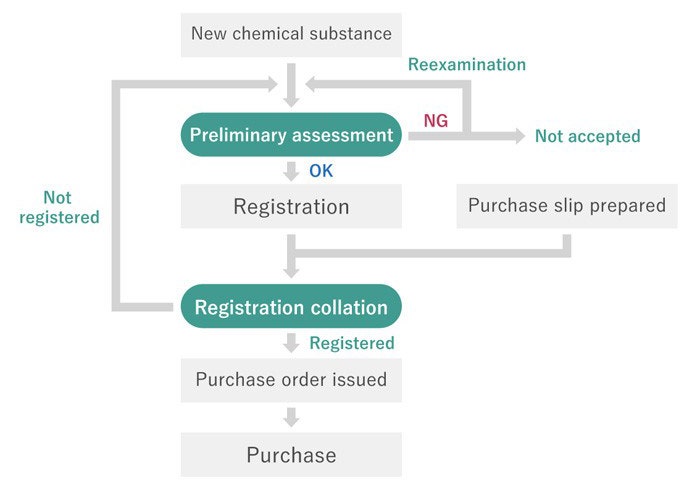
We conduct preliminary evaluations to examine potential environmental and safety concerns when a new facility is introduced or a chemical substance is used for the first time.
In the preliminary evaluations, we evaluate the environmental impact, hazards, and toxicity, the appropriateness of environmental and safety management, the conditions of use and management methods, and status of statutory compliance to determine whether or not the subject of the assessment can be introduced. Facilities and chemical substances that pass the screening shall be used under the specified conditions of use and management methods, and based on analytical measurements of exhaust gas, wastewater, and the like. In addition, we conduct a manufacturing method assessment as a preliminary evaluation of the environmental and safety aspects of the entire manufacturing process, including of the chemical substances, facilities, or other assessment subjects involved.
Conformance to the Pollutant Release and Transfer Register (PRTR) System
We manage the inputs and outputs of chemical substances (Class I Designated Chemical Substances) used by the NEC Group that are subject to the PRTR System and disclose the results. For chemical substances released into the atmosphere and public water bodies (including discharges into sewage systems), The Company manages those substances in accordance with its own voluntary standards, which are more stringent than the levels required by law.
Strict Control of Equipment and Parts Containing PCBs
We have stored disposed-of devices (equipment and parts, including fluorescent light stabilizers) containing polychlorinated biphenyls (PCBs) under strict control and have proceeded with planned disposal.
The amount of PCBs held by NEC (as of March 31, 2026) is as follows.
High concentration: 0 kg Low concentration: 56,552 kg Scope: NEC Corporation
Initiatives in Response to the Act on Rational Use and Appropriate Management of Fluorocarbons
We have established internal regulations based on the Act on Rational Use and Appropriate Management of Fluorocarbons, and strive to properly manage Class 1 Specified Products (commercial air conditioners, refrigerators, and freezers) and track fluorocarbon leakage volumes.
In fiscal year 2026, the calculated amount of fluorocarbon leakage was under 1,000 t-CO2, which is below the threshold requiring reporting to the competent minister.
The Company will continue working to prevent leaks—such as through reinforced inspections— and, during equipment upgrades, promote the use of non-fluorocarbon or low-GWP (Global Warming Potential) refrigerants to reduce fluorocarbon emissions.
Ozone-depleting Substances
The use of all specific chlorofluorocarbons as a cleaning agent in manufacturing processes was discontinued in 1993.
By the end of fiscal year 2011, efforts to totally discontinue the use of specific chlorofluorocarbons for refrigerant in air conditioners and specific halons used in fire extinguishers resulted in a reduction of 96%, almost completely eliminating their use.
Contribution through Our Businesses
Chemical Substance Management Solutions That Support Compliance with Environmental Laws and Regulations
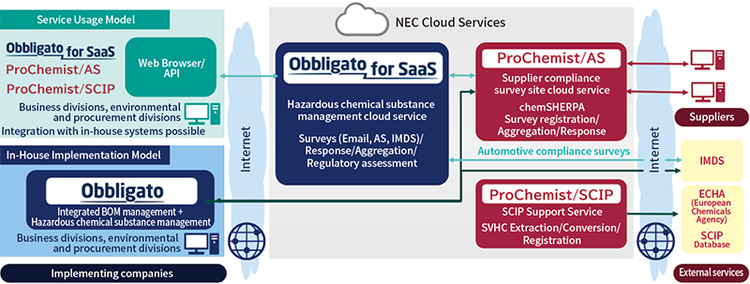
We provide chemical substance management solutions in the form of implementation packages and cloud services for compliance with various chemical substance laws and regulations around the world, such as the RoHS Directive and the REACH regulations. We also provide related business systems that address conflict minerals and have SCIP database registration functions.
Risk Management
Response to Situations Including Environmental Accidents and Violation of Laws
The party who discovers an environmental accident or violation of laws and regulations that may lead to environmental pollution shall contact the environmental manager at the relevant management unit. The environmental manager who receives the notification shall immediately implement emergency measures and prevent the escalation of the incident in accordance with emergency response and other procedures, and shall report the matter to the head of the environmental management department and the site manager of the relevant plant based on the Criteria for Determining the Necessity of Information Escalation in an Emergency Situation. The head of the environmental management department and the site manager shall contact the police, fire department, or relevant authorities as necessary, and inform the Corporate Officer in charge of the Environment.
At the same time, the environmental manager shall carry out corrective measures such as identifying the cause and implementing measures to prevent recurrence. The head of the environmental management department and the site manager shall confirm the content of the corrective measures, and if they deem the measures ineffective, shall make improvements and confirm that the corrective measures have been implemented and are functioning effectively, thereby preventing recurrence.
Indicators and Goals
procurement volume*1
(compared with fiscal 2018)
(compared with fiscal 2018)
*1 Substances subject to the PRTR System
*2 Substances subject to voluntary action plans in the electrical equipment and electronics industries
Other Initiatives
President Appears in WEF Panel Discussion "Tech's Answer to Pollution"
The President of The Company participated in the World Economic Forum Annual Meeting 2025 (in Davos) and spoke at the panel discussion titled "Tech's Answer to Pollution." He delivered messages on pollution issues that, despite increasing global attention, still lack effective international measures, such as plastic pollution and the contamination of air, water, and soil, highlighting Japan's history of pollution countermeasures, the role of technology, and recommendations for the international community. One reason modern pollution issues remain unresolved is the increasing complexity and globalization of supply chains. Business divisions, environmental and procurement divisions Implementing companies Main Initiatives.
He emphasized the importance of visualizing supply chains using ICT, and explained that technologies such as advanced satellite systems and traceability tools are already available. He also stressed the importance of environmental literacy, noting that consumer behavior and changes in investment flows can influence companies and drive behavioral changes in businesses.