Understanding Global Trends in Climate Change and the Risks and Opportunities for NEC
Policy
As part of its corporate social responsibility activities, the Company engages in environmental management. The Company seeks to reduce environmental impact across society by providing products and services, as well as reducing the environmental impact of its own business activities by conserving energy at its business sites, equipment, and during transportation and by reducing the chemical substances it uses. To promote environmental management groupwide— including at NEC on a non-consolidated basis, affiliated companies, production bases, and research facilities— the Company has established the NEC Environmental Policy, which sets out action guidelines. We work to ensure that all actions of employees and corporate officers comply with this policy. Furthermore, we require all suppliers, contractors, and other stakeholders in our supply chains to behave in a manner consistent with relevant guidelines and agreements while considering the environment. In addition, taking into account the mutual impacts among environmental issues, we manage them in an integrated manner while also being mindful of trade-off relationships in which responses to specific fields may impair other environmental issues.
NEC Environmental Policy
NEC views the operation of business in harmony with the environment as one of its top priority issues and is committed to reducing the environmental impact of the entire global supply chain and contributing to a sustainable society.
- We will create social value focused on delivering ICT solutions and services leveraging advanced technologies to contribute to their adaptation, and we will contribute to the reduction of the environmental burden on customers and the global environment and to the mitigation of the impacts of climate change.
- We will assess the environmental impact throughout the entire life cycle of ICT solutions and service development with considerations for reducing environmental burden.
- We will comply with environmental laws and regulations associated with our business activities, honor agreements with stakeholders, and strive to conserve energy, save resources, and prevent environmental pollution caused by chemical substances and waste along the entire supply chain.
- We will prioritize the procurement of environmentally friendly hardware, software, and services.
- We will disclose environmental information regarding our business activities, ICT solutions and services to our stakeholders.
- We will raise the environmental awareness of each and every one of our employees worldwide and contribute to the conservation of the global environment through the promotion of climate change action, resource circulation, and biodiversity.
- We will strive to improve an environmental management system with environmental targets and conduct periodic reviews to realize continual improvement.
Framework
Environmental Management Implementation Framework
Overview
NEC Corporation established a specialized environmental department in 1970, one year before Japan's Environment Agency was established, and for more than 50 years has worked to address pollution prevention and environmental conservation while promoting the creation of social value through the practice of environmental management.
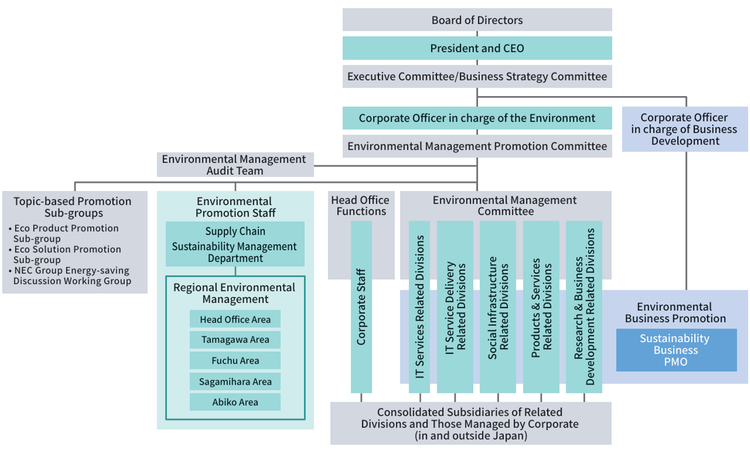
Important environmental matters are discussed by either the Executive Committee or the Business Strategy Committee. Discussions are limited to those deemed important based on deliberations by the environmental management committees in each relevant department, topic-based promotion sub-groups for each topic, and the Environmental Management Promotion Committee, which comprises managers in charge of the environment in each relevant division. Furthermore, issues that may have a particularly significant impact on the NEC Group's businesses are reported to the Board of Directors.
Each relevant division has established environmental management committees. In addition, a system has been established for carrying out specific measures by each business unit, its divisions, affiliated companies, and subsidiaries of NEC in and outside Japan. By formulating and implementing specific action plans based on the environmental strategy devised by either the Executive Committee or by the Business Strategy Committee, we can implement consistent environmental management throughout the NEC Group under the supervision of the Board of Directors.
For business development activities in which the environment is a new business opportunity, we have established a dedicated team called the Sustainability Business Project Management Office (PMO) to promote collaboration among all companies, including Group companies, and to accelerate commercialization.
Involvement with Industry Associations
To ensure consistency between the Company's own position and that of industry associations, NEC participates in various organizations as a committee member and engages in active discussions. In discussions, we keep in mind whether the position aligns with NEC's values and whether it follows global initiatives such as the Paris Agreement. If any discrepancies arise, the matter is brought back internally and adjustments are made through the Environmental Management Promotion Committee and other relevant bodies, based on the environmental management system, to clarify the Company's position. Through this process, NEC aligns its initiatives related to climate change, natural capital, and other sustainability issues with the activities of industry associations.
Major Industry Associations in Which We Participate
(Keidanren)
Subcommittee
Committee on Environment and Safety:
Subcommittee on Global Environment / Working
Group on Global Environment Strategy /
Subcommittee on Waste & Recycling /
Subcommittee on Environmental Risk Response
Nature Conservation Council
The Company's corporate officer in charge of
the environment participates as a member of
the Committee on Environment and Safety and
the Committee on Energy and Resources. We
formulate policy proposals on global warming
countermeasures and energy measures
utilizing IT.
Information Technology
Industries Association
(JEITA)
Promotion Committee, Environmental
Management Committee, Sustainable IT
Promotion Committee, Impact Assessment
Committee, Advanced Topics Study Group
companies. It covers a wide range of topics including
chemical substances and climate change.
Management Association
for Industry, Japan LCA
Forum
Conducts environmental impact assessments
that include natural capital using LIME3.
electronic industry
associations: JEITA, JEMA,
JBMIA, CIAJ
Liaison Group of Japanese Electrical and
Electronics Industries for Global Warming
Prevention, Steering Committee, Product
Contribution Expert Committee, etc.
Conduct deliberation and guidance from a
managerial and strategic perspective through
each committee and working group regarding
global issues in the electrical and electronics
industry and policy proposals to governments
in and outside Japan.
Green x Digital
Consortium
(JEITA)
Activities toward establishing a mechanism to
visualize CO2 data across the global supply
chain as a whole in order to reduce Scope 3
Category 1
electronic industry
associations: JEITA, JEMA,
JBMIA, CIAJ
Environmental Activity Data Value Creation
Working Group
Consideration and proposals toward
establishing a mechanism under which green
value is appropriately evaluated in the market
Participates in international discussions on
rules and procurement approaches, etc. toward
achieving 100% renewable energy.
The World
Economic Forum
Committee member, "Nature Positive: Role of
the Technology Sector"
Formulates guidance on priority initiatives for
the IT sector.
The World
Economic Forum
Committee member, "Green Data Center
Playbook" development
Organizes approaches to environmental
considerations for data centers.
Committee member, "Technology and
communications Sector Guidance" formulation
Formulates proposals for indicators for
initiatives in the IT sector.
Advisor, "Nature Intelligence for Business Grand
Challenge"
Serves as an advisor for a digital tool
development competition to enable SMEs to
work on TNFD.
3. Life cycle Impact assessment Method based on Endpoint modeling 3: A method for analyzing global environmental impacts, such as effects on human health and species extinction.
Policy Engagement
NEC Europe's Brussels Office is responsible for external affairs activities relating to the European Union's (EU) digital policy and environmental policies, including climate change, chemicals management, and the circular economy. It plays a central role in monitoring environmental developments in the EU and coordinating the NEC Group's response. By keeping abreast of the latest developments in European policies, laws, and regulations, the Office works closely with NEC headquarters to develop and implement strategic responses. Since its establishment in 1995, the Office has maintained a sustained commitment for more than a quarter of a century, particularly in the field of environmental policy.
The Office has actively participated from an industry perspective in the development of major EU environmental product regulations, including the WEEE Directive (Waste Electrical and Electronic Equipment Directive), the RoHS Directive (Restriction of Hazardous Substances Directive), the REACH Regulation (Registration, Evaluation, Authorisation and Restriction of Chemicals), and the Ecodesign for Sustainable Products Regulation (ESPR). In particular, from the early to mid-2000s, the Office chaired the Environment Committee of the Japan Business Council in Europe (JBCE) and also played a leading role in environmental committees and working groups at DIGITALEUROPE.
In the mid-2000s, the Office also served as the inaugural chair of the JBCE CSR Committee, promoting responsible corporate conduct from a sustainability perspective. In recent years, it has supported the development of initiatives at NEC headquarters relating to sustainability regulations and frameworks concerning corporate sustainability disclosure and responsible business conduct, including the EU Taxonomy Regulation, the Corporate Sustainability Reporting Directive (CSRD), and the Corporate Sustainability Due Diligence Directive (CSDDD). This support includes detailed monitoring of regulatory developments, impact assessments, and analysis of legal interpretations.
The Office also places strong emphasis on policy advocacy with EU regulatory authorities, supporting the development of effective legal and regulatory frameworks toward the realization of a sustainable society. In addition, it works closely with Japanese government ministries and agencies, as well as Japanese industry associations such as the Japan Electronics and Information Technology Industries Association (JEITA), the Japan Electrical Manufacturers' Association (JEMA), and the Japan Machinery Center for Trade and Investment (JMC). Drawing on Japan's advanced environmental technologies and expertise, the Office works to reflect Japanese perspectives in the EU environmental policymaking process and promote understanding of EU laws, regulations, and requirements, while contributing to constructive dialogue with regulators and policymakers.
Through these activities, the Company serves as a bridge between Japan and the EU and, as a responsible corporate citizen, seeks to contribute to the realization of a sustainable society in which industry and regulatory authorities work together and grow together.
Environmental Management System
Environmental Audit and ISO 14001 Inspection
Based on ISO 14001, the Company promotes the establishment and operation of an environmental management system across the entire Group.
To confirm the operating status of the environmental management system, we conduct in-house environmental audits implemented by each NEC Group company in Japan and environmental management audits implemented by the Company's Environment Management Department for the Group as a whole.
In environmental management audits, auditors with specialized expertise, including certified environmental management system auditors, confirm the operating status and effectiveness of in-house environmental audits, and also focus on confirming the relationship between each department's operations and the environment. In addition, they comprehensively confirm the implementation status of overall environmental activities, including the development of environmentally conscious products, initiatives to reduce environmental burdens, environmental risk management, and compliance status with ISO 14001.
The results of these confirmations are also verified through ISO 14001 audits undertaken by an external third-party certification body.
ISO 14001 Certification
ISO 14001 Standard for Environmental Management Systems: Certification (As of April 2026)
in Japan
outside Japan
NEC Group Companies List with ISO 14001 Certification
ISO 14001 Certification Registrations in the NEC Group
Environmental Due Diligence
The NEC Group promotes environmental due diligence based on international norms such as the OECD Due Diligence Guidance for Responsible Business Conduct. The NEC Group's environmental due diligence aims for efficient operation by integrating it with existing environmental management systems and environmental information disclosure frameworks such as ISO 14001 (EMS), TCFD, and TNFD, as well as sustainable procurement activities.
In fiscal year 2026, the Company participated in the Ministry of the Environment's support project for promoting environmental due diligence, and worked to further strengthen its activities. The scope covers not only the Company's own business but also focuses on identifying, evaluating, and mitigating environmental risks across the entire value chain (climate change, water, soil, air, chemical substances, biodiversity, etc.). In activities in fiscal year 2026, we utilized United Nations Environment Programme Finance Initiative (UNEP FI) tools and CSR Risk Check to conduct upstream supply chain risk assessments in business domains with high environmental burdens. In addition, to address these risks, we also considered stakeholder engagement, the appropriate form of corrective actions, and strengthening grievance mechanisms. Going forward, we plan to proceed step-by-step in addressing identified environmental risks, starting with those of higher priority.
Environmental Management Strategy
The Company promotes and strengthens environmental management from two angles: by reducing our own environmental footprint and by helping customers reduce their environmental impact through the use of NEC Group products and services.
To reduce our environmental footprint, the NEC Group conducts a wide range of activities, including reducing CO2 emissions across the supply chain, expanding the use of renewable energy, cutting water consumption and waste output, promoting resource circulation, preserving endangered species, and ensuring compliance with environmental laws. We are also involved in creating environmental rules and policy proposals through industry-academiagovernment collaboration.
Starting in fiscal year 2025, we are placing special emphasis on the "Client Zero" initiative, which leverages our value creation model, NEC BluStellar, to solve customer issues while reducing environmental impact through our products and services. "Client Zero" is the idea of using NEC Group itself as the initial client field to test and implement the latest technologies, driving internal transformation and using the firsthand knowledge and experience gained as a reference to create solutions that help customers tackle environmental challenges. NEC BluStellar is a value creation model that starts with the customer's management challenges and provides end-to-end business solutions to help solve them.
1. Environmental Client Zero Strategy
In the past, addressing environmental issues was hindered by problems such as overly individualized know-how and reliance on manual processes. The Company is taking the lead in using digital transformation (DX) to quantify data and reform operations, aiming to resolve these challenges and tackle environmental issues. We aim to integrate non-financial data with financial data through DX, embedding environmental perspectives into all supply chain processes as a matter of course, and ensuring access to necessary information to achieve sustainable, data-driven management. The knowledge gained through this initiative will also help customers overcome challenges in advancing their own environmental management.
With the introduction of various environmental regulations and carbon taxes, customers are facing increasingly complex environmental management challenges. In Japan, some companies are beginning to see regulations and decarbonization as business opportunities and are placing sustainability at the core of their management strategies. Since around 2021, the number of inquiries we receive from customers about environmental issues has surged. Initially, demand focused on visualization tools for Scope 3 emissions, but over time, customer needs have shifted toward visualizing CO2 emissions at the product level and identifying non-financial risks and opportunities linked to financial affairs, which cannot be addressed with tools alone.
As an ICT company, the Company sees business opportunities in helping customers address their management challenges. We offer services tailored to each customer's stage of progress, leveraging the know-how gained as Client Zero in our consulting services, and work alongside customers to solve their challenges.
2. Utilizing AI for Natural Capital Risk/Opportunity Assessment (TNFD × AI)
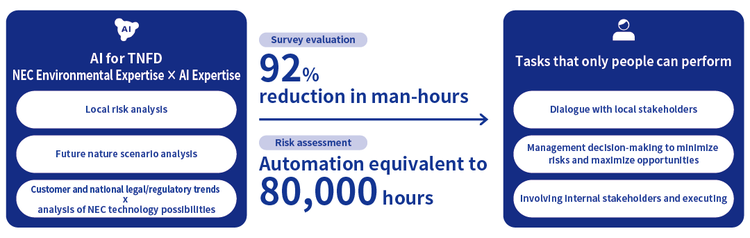
Natural capital cannot be measured with a single indicator such as CO2 emissions, and as international rule development is still in progress, many companies face challenges in assessing business risks and opportunities. By utilizing generative AI and agentic AI, the Company has significantly improved the amount of information and the accuracy of analysis. As a result, personnel have become able to focus on essential work such as building relationships of trust with stakeholders and formulating and executing strategies, and by combining the capabilities of AI and people, we are linking this to the creation of management value. This AI is included in the TNFD Accompaniment Support Service that the Company has been providing since 2023, and is currently provided as a consulting service. We have secured inquiries and orders from dozens of companies, generating results that steadily contribute to business from Client Zero.
3. Utilizing AI for ESG Survey Response Operations (CDP × AI)
The Company is promoting operational reform utilizing generative AI to improve efficiency in responding to CDP, which is an important indicator of ESG evaluations. By utilizing AI for work requiring advanced expertise, such as understanding complex standards, information gathering and analysis, and document preparation, we achieve both improved efficiency and enhanced quality. In particular, in the response drafting process, we have built a mechanism that enables responses to be prepared efficiently and at a consistent quality level. This has achieved an approximately 30% reduction in response man-hours and an improvement in response quality. We will reduce workload and advance standardization, and will proceed with expanding this to future information disclosure operations.
4. Utilizing AI for SSBJ Compliance Operations (SSBJ × AI)
In preparation for preparing securities reports compliant with SSBJ standards, which will be applied from the fiscal year ending March 2027, we are working to improve the efficiency and sophistication of disclosure operations through the use of generative AI. Under the Client Zero concept, we ourselves take the lead in confronting issues in disclosure operations and return the insights gained there to support society and companies. Disclosure operations span a wide range, from understanding standards to collecting and analyzing information and drafting text in accordance with frameworks. In addition, under limited staffing and organizational structures, leveling quality and addressing labor shortages have become issues. Leveraging knowledge cultivated through TNFD initiatives and responses to external evaluations, we developed AI that supports (1) interpreting requirements, (2) collecting and analyzing internal and external public information, and (3) drafting, targeting the climate standard (S2). In trials within the Company, we confirmed a 93% reduction in man-hours compared with conventional processes centered on manual work, and confirmed that even less-experienced personnel can prepare disclosures at a certain level of quality.
5. Utilizing AI for Compliance with Product Environmental Laws and Regulations (Environmental Laws and Regulations × AI)
Environmental laws and regulations related to products have become more complex in their institutional frameworks and increased in information to be referenced, as the target regions and product domains have expanded. In addition to the high level of specialization of legal documents and the inclusion of abstract expressions, many are also published in local languages; as a result, translation, reading, and interpretation impose a significant burden.
Within the Company, we organize such laws and regulations and create internal guidelines summarizing the response items required for compliance. On the other hand, differences in legal interpretation and guideline descriptions tend to arise depending on the experience of the person in charge, which leads to person-dependent operations and variations in the quality of deliverables. In addition, creating guidelines requires a wide range of tasks, including summarizing key points, formatting adjustments, adding citations of provisions, and confirming specific information such as penalties.
Accordingly, we are working to improve the efficiency of routine operations using AI, including information collection, translation and summarization, draft creation, presenting check viewpoints, and organizing information in table format. On the other hand, for work requiring advanced expertise—such as identifying applicable laws and regulations, organizing issues where interpretations differ, and making final judgments—people are responsible, thereby advancing an appropriate division of roles between AI and people.
Through this, we aim to improve efficiency and standardization of operations related to compliance with product environmental laws and regulations, and to enhance guideline quality and sophistication of review.
Environmental Risks
Environmental Risk Countermeasures
Recognizing the impact that such environmental risks as climate change and pollution by hazardous substances could have on its businesses, NEC conducts risk reduction and prevention activities through assessment, inspection, and education.
We classify risk countermeasures under three risk categories: plantrelated risks, product-related risks, and sales and maintenance-related risks. In the first category, countermeasures for plant-related risks cover risks related to leaks of hazardous substances, soil contamination, and groundwater contamination caused by natural disasters or equipment failure. To help prevent such environmental accidents, we conduct prior environmental risk assessments as well as education and training. In the second category, countermeasures for product-related risks are focused on risks such as the inclusion in products of substances regulated by the Restriction of Hazardous Substances (RoHS) Directive in the European Union and violations of labeling regulations. To address such risks, we conduct product assessments to ensure strict compliance with guidelines and use in-house systems to implement centralized management of information. As for the third category, countermeasures for sales and maintenance-related risks are aimed at mitigating such risks as violations of the Waste Management and Public Cleansing Act due to inadequate consignment of waste treatment. Our countermeasures include efforts to ensure compliance by issuing guidelines on waste and regularly conducting education for sales department personnel. In conjunction with these efforts, we have established the Environmental Escalation Manual for Emergencies to strengthen our governance of environmental risks.
Our risk management system includes the Risk Control & Compliance Committee. If a risk is identified that may have a significant effect on businesses, the Risk Control & Compliance Committee deliberates on countermeasures. The committee fulfills a supervisory function for specific risk measures by checking the results of activities, problems, and future plans and by issuing directives on where measures should focus. Further, reports are submitted to the Executive Committee and the Board of Directors, as necessary.
Legal Violations, Accidents, and Complaints
Since fiscal 1998, the Company has disclosed on its website whether any environmental fines or penalties have been imposed. In fiscal 2025, there were no environmental fines or penalties incurred either internally or externally.
In fiscal 2025, there were no environmental accidents that had an external impact, two environmental accidents that did not have an external impact, and no complaints.
Prevention Activities: Group-wide Dissemination of Information on Near-misses
Since the latent causes of environmental accidents are present in minor accidents, we thoroughly investigate their causes and implement technological countermeasures even for minor incidents at the near-miss level.
NEC's findings are then passed on to affiliated companies in Japan and abroad, and corrective measures are checked. In this way, we advance accident prevention.
Soil
Among the substances covered by the Soil Contamination Countermeasures Act, NEC completely discontinued the use of the VOCs trichloroethylene and tetrachloroethylene in 1998 and 1,1,1-trichloroethane in 1993. Further, as far as possible NEC has continued to conduct independent soil surveys.
We will continue to conduct soil surveys and comply with the Soil Contamination Countermeasures Act, related ordinances, and the directives of the administrative agency with jurisdiction and will continue taking appropriate measures.
Environmental Training
Aiming to realize the Purpose of the NEC Way, we heighten employees' environmental awareness through environmental education that targets specific business divisions and employee ranks.
For completion rates, see 3. Build foundations to promote environmental management
employees
environmental
auditors
employees
employees