The Company expressed its support for the Task Force on Climate-related Financial Disclosures (TCFD) and its recommendations in 2018 and provides disclosures on this page based on the TCFD framework.
Governance
Climate Change Countermeasure Implementation Framework
In the Environmental Management Implementation Framework, The Company engages in environmental management as well as climate change.
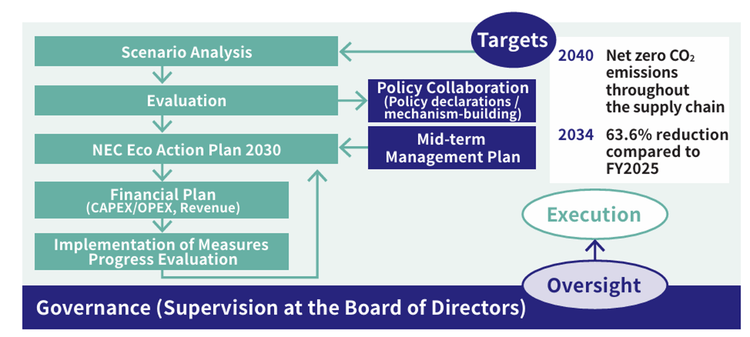
Within the framework described in Environmental Management Promotion Framework, we are also implementing climate change measures. The NEC Group's environmental policies and goals regarding climate change are discussed and formulated by the Environmental Management Promotion Committee, which is made up of the managers in charge of the environment from each business unit. The Corporate Officer in charge of the Environment confirms the council's proposals and reports them to the Business Strategy Committee, an organization that is further up the organizational hierarchy. Risks related to climate change are also shared at the Environmental Management Promotion Committee. The Corporate Officer in charge of the Environment confirms those risks that could have a significant impact on businesses and, as necessary, deliberates these risks at the Risk Control and Compliance Committee in accordance with the risk management process.
In particular, climate risks and opportunities that could significantly affect businesses are also reported to the Board of Directors, as necessary. Through deliberation, the Board of Directors gives instructions on relevant measures, thereby providing supervision that ensures that NEC advances appropriate climate change measures.
In addition, as part of our climate change measures, we are advancing groupwide measures to reduce our in-house CO2 emissions by addressing specific aspects of the issue through special committees. By reporting and submitting proposals to the Environmental Management Promotion Committee, these special committees facilitate the groupwide pursuit of energy-saving initiatives. Decisions made at the Environmental Management Promotion Committee are reported and instructed at each business unit and plant committee, and are then communicated to and thoroughly implemented by all employees.
Participation in Initiatives Related to Climate Change
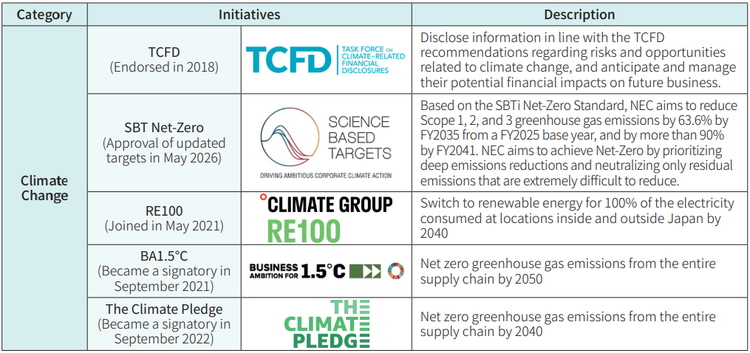
The Company is participating in climate change initiatives to build a sustainable business foundation for itself and promote the realization of a sustainable society through co-creation.
Involvement with Industry Associations
Environment-related Reports for Main Committees
Since climate change is positioned as one of the issues in NEC's materiality, committees attended by the President deliberate, supervise and report on initiatives, risks and opportunities related to the environment, including climate change. The committees met four times in fiscal year 2026.
Key Discussions, Audits, and Reports
FY20232 timesMay: NEC's Approach to Sustainability Promotion and Key Initiatives
February: Business Risks and Opportunities in the Natural Capital FieldFY20232 timesMay: NEC's Approach to Sustainability Promotion and Key Initiatives
February: Business Risks and Opportunities in the Natural Capital Field
May: Activities for Carbon neutral
July: Issue of Sustainable linked bond
October: Climate Change Summit
February: NEC's environmental initiatives
Strengthen carbon neutral measures in the future
May: Report on ESG and sustainability promotion activities
December: Report on participation in COP28
July: Ranked 2nd in TIME's "World's Most Sustainable Companies of 2024" Report on our initiatives in the Adaptation Finance Business
January: World Economic Forum Annual Meeting in Davos (Report on NEC's President taking the stage and discussing the topic of environmental pollution)
April 2025 Discussion of the Company's sustainability management policy
July 2025 Ranked 7th in TIME's "World's Most Sustainable Companies of 2025"
October 2025 Reported that we obtained the highest "AAA" rating in the "MSCI ESG Rating"
March 2026 Discussion on priority initiatives for realizing our sustainability to achieve the Vision for Creating Social Value
September: How to face sustainability, including climate change
March: ESG-Day
May: NEC's Approach to Sustainability Promotion and Key Initiatives
February: Business Risks and Opportunities in the Natural Capital Field
June: Sustainability Strategies that Contribute to Enhancing Corporate Value
March: The Role of Sustainability Management in an Era of Rapid Change
September: Sustainability-related Risks and Opportunities in NEC's Sustainability Management
March: NEC's Environmental Initiatives during the New Medium-term Management Plan Period
Strategy
The Company conducts evaluations from the perspectives of both "impact on the environment and society" and "risks and opportunities for its own finances," and identifies themes where both of these impacts are high as those of the highest importance to the NEC Group, disclosing them in the Annual Securities Report.
On the other hand, with respect to climate change, we recognize it as a theme with a large impact on the environment and society, and we currently expect that the risks and opportunities to our own finances will have only a limited impact on business performance at this time. In this ESG Databook, including such themes, we broadly disclose to stakeholders our Group's initiatives on climate change.
Climate Change Countermeasure Policy
The Company has positioned Environmental Action with a Particular Focus on Climate Change (Decarbonization) as one of its priority management themes from an ESG perspective – materiality. As a result, The Company will not only make efforts to reduce the environmental impact of its products and services, but will also support customers and society in their decarbonization efforts by utilizing ICT. Based on this approach, The Company formulated the Course of Action for Climate Change Toward 2050, declaring its intent to reduce its CO2 emissions to net zero as a long-term environmental goal.
At present, we have moved up our carbon neutrality target to 2040 pursuant to signing The Climate Pledge, and are implementing initiatives after changing the language of our climate change guidelines to move up the year for achieving our carbon neutrality target to 2040.
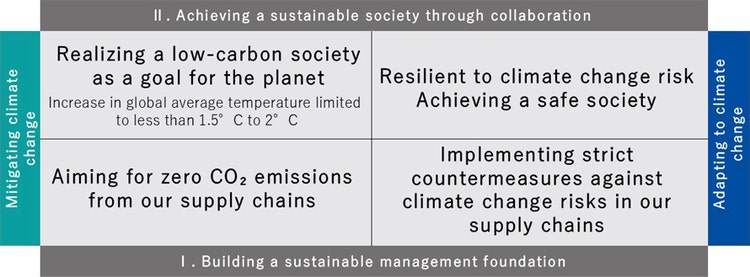
Aiming for reductions to achieve zero CO2 emissions from our supply chain by 2040, we obtained SBT Net-Zero certification in April 2024 and have intensified action. Given the global goal of achieving a low-carbon society, we established the Carbon Neutral Business Promotion PMO and are implementing initiatives throughout the Group that involve reducing energy use in our ICT infrastructure, visualizing solutions for CO2 emissions, resource aggregation businesses, and environmental consulting.
Climate Transition Plan
The Company has formulated a climate transition plan by organizing existing guidelines and initiatives to enable a transition to a business model in alignment with the 2050 net-zero society consistent with the goals of the Paris Agreement. The process involves a PDCA cycle that includes forecasting via scenario analysis, clarification of business risks and opportunities, formulation of a medium- to long-term plan, and implementation and evaluation of measures.
In addition, we report on the progress of these initiatives to the Board of Directors and disclose information in line with TCFD recommendations. In advancing our climate transition plan, we engage in collaborative policymaking as needed to achieve policies aligned with the Paris Agreement.
Contributions through Businesses
Contributing to Customers'Environmental Management Challenges
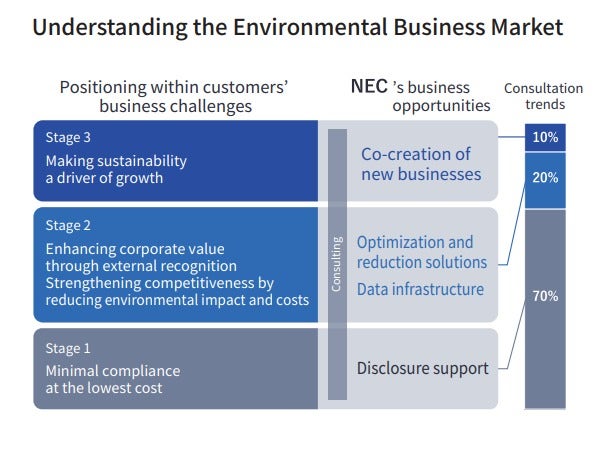
In the "Environmental Management Strategy" section, we outlined the Company's approach and goals in addressing environmental management challenges, and we recognize that our customers face similar issues.
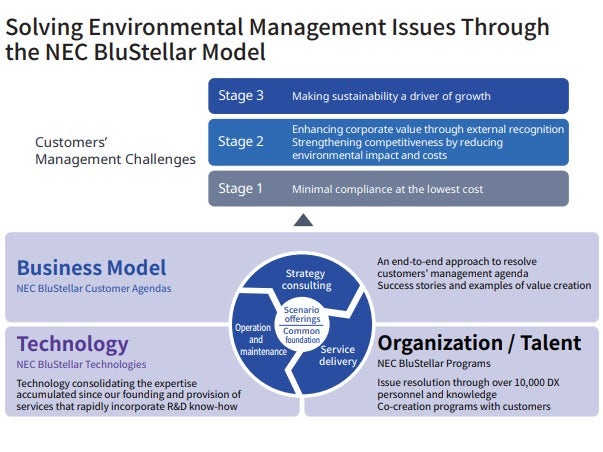
We recognize that customers are at varying stages in their efforts to address management issues: Stage 1, where they are responding with minimal cost to meet customer demands and regulatory requirements; Stage 2, where they aim to reduce environmental impact and improve competitiveness while enhancing corporate value through earning external recognition, in light of rising carbon taxes and energy costs; and Stage 3, where environmental initiatives are integrated into their growth strategies, going beyond cost savings and value enhancement. The Company believes it can contribute in various ways tailored to each customer's stage, drawing on its own experience.
In 2024, the Company introduced NEC BluStellar, an end-to-end business model that creates value starting from customers' management challenges. The Company applies the NEC BluStellar value creation model in its environmental business as well. By leveraging technologies such as sensing, AI, and security, along with highly regarded external experts and knowledge, we visualize and analyze complex environmental issues to clarify the challenges that need to be addressed. Through the Client Zero approach, which treats NEC itself as the first client for value verification, and co-creation with clients, we clarify issues and effects, contributing to the establishment of industry standards.
Internal Validation of Product Carbon Footprint (CFP) Calculation Begins
Toward realizing a decarbonized society, societal demand is increasing to visualize CO2 emissions across the entire product lifecycle. In light of these trends, we are advancing the development of a CFP calculation solution.
For this development, we formed a working group spanning various internal domains, including consideration of application, tool development, and production sites, and are conducting internal verification.
In fiscal year 2026, we established a mechanism to consolidate internally scattered data required for CFP calculation and to organize it in a form that can be easily linked to emission factors and used for calculation.
While many tools in the market focus mainly on calculation and visualization, we will contribute to solving customers' issues toward decarbonization through practical solutions that simplify data linkage processes.
We also worked on obtaining primary data from our business partners. To conduct hotspot analysis based on CFP calculation results and to formulate effective reduction measures, it is essential to increase the ratio of primary data that can directly reflect emissions reduction efforts across the supply chain. Going forward, we will continue to obtain primary data in cooperation with our business partners and aim to reduce environmental burdens across the entire supply chain.
Initiatives to Reduce Scope 3 Category 11
The Company's CO2 emissions for its products (Scope 3, Category 11) are estimated based on scenarios set using catalog values and other data. As a result, it is difficult to grasp CO2 emissions that reflect actual customer usage conditions. On the other hand, some customers use renewable energy, and therefore actual CO2 emissions are considered to have been reduced. Such information is being published on each customer's website.
NEC proposed at the Product Contribution Expert Committee of the Liaison Group of Japanese Electrical and Electronics Industries for Global Warming Prevention that we develop a calculation method for Scope 3 Category 11 that reflects actual customer conditions. In fiscal year 2026, the calculation methods were summarized in the "Report on Study of Scope 3 Category 11 Calculation Method Reflecting Actual Customer Conditions."
Currently, we are conducting trial calculations of CO2 emissions that reflect customer usage based on this report.
Scope 3 Category 1 Initiatives
With respect to Scope 3 Category 1, we are working with our suppliers to encourage them to calculate their CO2 emissions and support their emissions-reduction through engagement with suppliers. Category 1 emissions that we have disclosed to date were calculated using an emission factor database. However, this method did not adequately reflect suppliers' emissions-reduction efforts.
To resolve this issue, we developed an in-house calculation methodology compliant with the GHG Protocol Scope 3 Standard. This methodology enables CO2 emissions reported by suppliers through self-assessment questionnaires (SAQs) to be incorporated into the calculation of our Scope 3 Category 1 emissions. This methodology has been reviewed by an independent third-party assurance provider regarding conformity with the Standard, and we have begun applying it to calculation from the fiscal year 2026 results onward.
As a result, it became possible to calculate emissions reflecting supplier-specific data. In the fiscal year 2026 results, emissions based on such data accounted for approximately 11% of total Category 1 emissions. In addition, the calculated amount of Category 1 emissions was approximately 13% lower than the value disclosed in the previous fiscal year, partly due to the application of the new calculation methodology.
Going forward, we will strengthen data collection through engagement with suppliers and provide the insights gained through this initiative to customers facing similar issues.
Scenario Analysis
In order to build a sustainable management foundation for NEC and promote the realization of a sustainable society through co-creation, we analyze the risks and opportunities that affect the environment and are implementing measures to reduce risks and increase opportunities.
In fiscal year 2025, we utilized AI for the first time to reassess companywide and business-specific risks.
Risks and Opportunities Presented by Scenario Analysis
*2 1.5°C: A scenario in which society decarbonizes and temperatures have risen by 1.5°C in 2100
4.0°C: A scenario in which society does not sufficiently decarbonize and temperatures have risen by 4.0°C in 2100
*3 Short-term = 0-3 years, medium term = 4-10 years, long term = 11-20 years
*4 Risks arising from changes in policies, laws, technological innovations, and market preferences during the transition to a decarbonized society
*5 An initiative established by four organizations: Carbon Disclosure Project (CDP), United Nations Global Compact (UNGC), World Resources Institute (WRI), and World Wide Fund for Nature (WWF). The initiative encourages companies to set science-based targets for reducing CO2 emissions
*6 Acute risks from events caused by abnormal weather (floods, landslides, etc.) and chronic risks from long-term changes in weather patterns (rise in sea level, heat waves, changes in suitable land for cultivation, etc.)
NEC's Vision for 2030/2050: Our Future Lifestyles and Local Governments
The Company believes that a company cannot continue to exist and grow without analyzing scenarios for climate change. Among recent global risks, climate change risks are numerous and could have an extremely large impact on not only corporate business activities and earnings but also our livelihoods. No matter what future is in store for us, based on multiple scenarios, The Company will examine steps that should be taken to realize a safe and secure society while surviving and growing itself. In 2019, we conducted a Companywide scenario analysis, and in two different scenarios, we analyzed potential changes in risks and opportunities for NEC.
We envisioned "climate change x government DX" (FY2023)
Since fiscal 2022, we have been conducting scenario analysis for each of our various business fields because the climate change risks and opportunities differ depending on the field. In fiscal 2023, in the domain of "digital government," we used the 1.5°C and 4°C scenarios to evaluate NEC's business opportunities in government digital transformation (DX) in Japan and the transition to a decarbonized society in 2030. Specifically, we drew up a picture of "climate change x government DX" in 2030, and considered the business concept proposal based on the company's risks and opportunities. Furthermore, we have enhanced our external hearings in order to reflect the voices of our stakeholders, .
Our Future Lifestyles and Local Governments
Results of Scenario Analysis (2030): World Envisioned by NEC in 2030 and 2050
climate change x government DX
The Company created scenarios for 2030 and 2050 to envision the impact of climate change on the future of regions and local governments (core cities and small-scale cities). We evaluated four scenarios, with the 1.5°C and 4°C scenarios in the transition to a carbon-free society on the vertical axis, and the relationship of citizens with their governments and the state of government systems, separated by enforced actions and voluntary actions, on the horizontal axis. In each scenario, we used some items related to climate change and decarbonization, with assumptions for 2050 in the following scenarios.
Referenced Published Scenarios
- IPCC AR6 WG1 SSP1-1.9
- IPCC 1.5°C Special Report
- IPCC AR5 RCP2.6
- IEA World Energy Outlook 2021
Net Zero Emissions by 2050
Scenario (NZE) - National Institute for
Environmental Studies, Japan,
Version SSP SSP1: Sustainable,
SSP5: Reliance on Fossil Fuels
- IPCC AR6 WG1 SSP1-8.5
- IPCC AR5 RCP8.5
- IEA World Energy Outlook 2021
Stated Policies Scenario (STEPS) - National Institute for
Environmental Studies, Japan,
Version SSP SSP3: Regional
Divisions, SSP4: Disparities
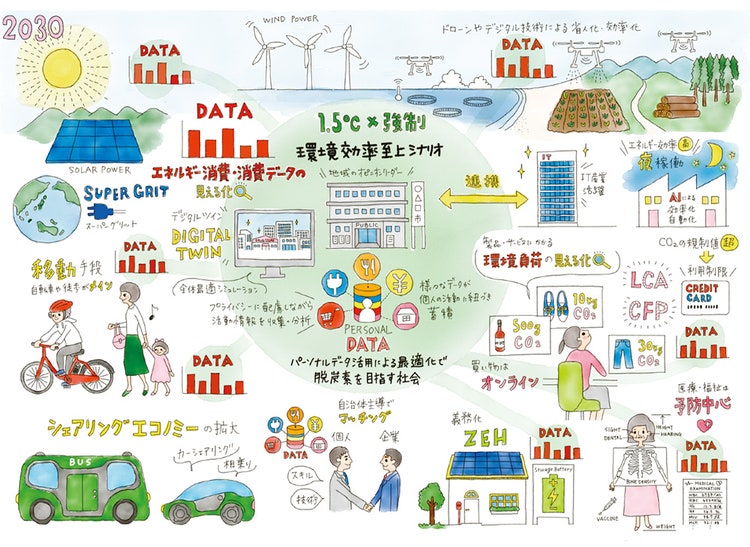
Forced environmental supreme efficiency scenario
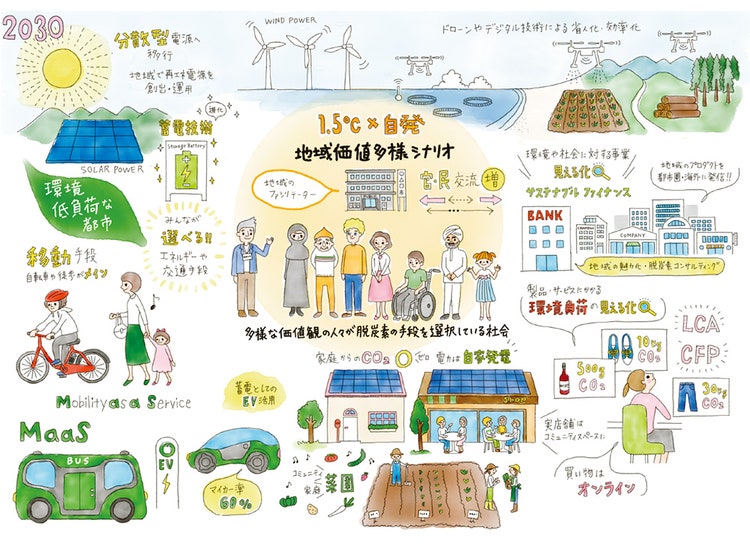
Spontaneous regional value diversification scenario
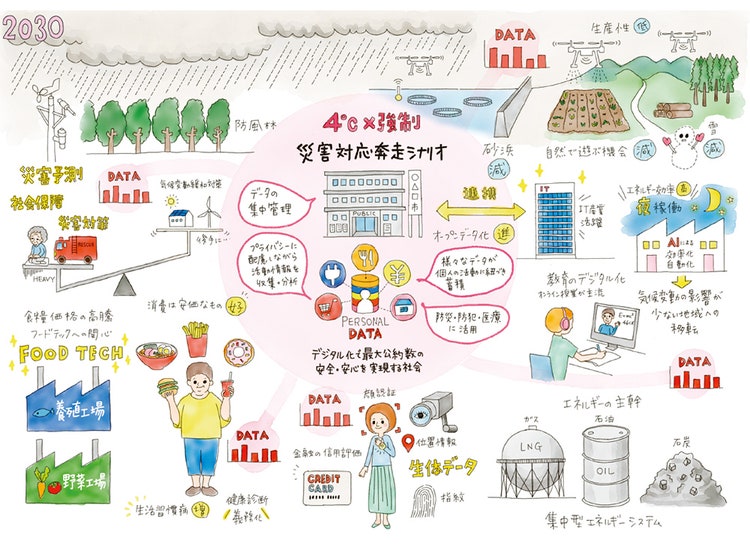
Forced disaster response scramble scenario
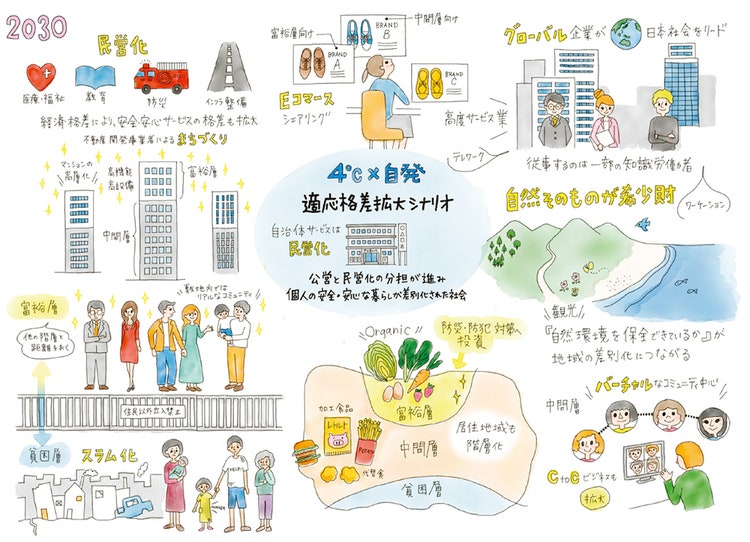
Spontaneous wider adaptation gap scenario
Scenario:Our Future Lifestyles and Local Governments
* Vertical axis: Realization of 1.5°C carbon society (global temperature up 1.5°C in the year 2100) and 4°C failure (global temperature up 4°C in the year 2100)
Horizontal axis: Forced and spontaneous aspects of relationships between residents and governments and state of government systems
Risks and Opportunities Based on Scenario Analysis
- National and local policies and public concerns are focused on well-being and the environment.
- Decarbonization policies are a top priority for national and local governments, and the transition to a decarbonized society is under way due to legislation introduced in the 2020s combined with the efforts of companies and local governments.
- Areas at the forefront of decarbonization are introducing renewable energy and promoting energy management, with net zero CO2 emissions in the consumer goods sector.
- The penetration rate of the My Number Card is 100%. The number of administrative services that provide incentives and subsidies using this card is increasing, encouraging citizens to change their behavior.
- Renewable energy-based distributed power sources
- Increasing use of electric vehicles
- Incentives for environmental activities
- Visualization of natural capital
- Increased awareness of well-being
- Disaster preparedness planning using digital twins
- Post-disaster support using the My Number Card
- Local governments outsource and privatize some operations
- Increase in data centers using renewable energy
- Healthcare business expands as health incentives become more significant
- Systematization of frameworks for emissions calculation, carbon taxes, emissions trading and carbon footprint
- Expanding markets for sensing, visualizing and quantifying ecosystems, environmental conservation, losses and damage
- Increased use of image analysis technology in compact cities
- Transformation of conventional business models due to the progress of government DX and the increased standardization and commonality of systems
- Intensifying competition with competitors and new entrants
Decarbonization support services for
local governments that visualize
resident initiatives and administrative
policy outcomes
4°C and disaster preparedness:
Pre-disaster (disaster self-sufficiency
simulation); during disaster
(uninterrupted telecommunication,
damage certification issuance
support); post-disaster: volunteer
support promotion system
Both scenarios and healthcare: Data
utilization system to improve local
branding based on healthcare for
4°C visitors and environmental value
- Many regions of Japan are confronted with rapidly declining population and financial difficulties.
- National and local governments struggle to provide infrastructure and services for all citizens.
- Wide-area collaboration and public-private partnerships gain traction. Climate change mitigation is deprioritized due to limited administrative staff, funding and other resources.
- Enhanced crisis management capabilities and continuity of administrative functions are required in anticipation of increasingly frequent, large-scale disasters, and adaptation initiatives are prioritized.
- Growing community disparities, stratification and division are affecting all aspects of policy from economics and finance to welfare, education and urban planning, and are becoming social issues.
- Disaster preparedness planning using digital twins
- Post-disaster support using the My Number Card
- Fossil fuel-based centralized energy systems
- Rising prices for energy, food and other commodities
- Cars are primarily for household use
- Decrease in natural capital
- Increased needs for disaster preparedness and mitigation, and for solutions during and after disasters
- Creation of administrative solutions using personal and administrative data
- Growing needs for agricultural products that are resilient to climate change
- Increase in solutions for introducing renewable energy and promoting local energy production for local consumption
- Entry into the personalized medicine and online medical care markets
- Coordination of supply chain BCP among industries
- Growing security business needs
- Contracting markets and decrease in business opportunities due to fewer customers and system integration
- Intensified deregulated competition
- Resistance to the use of personal and biometric information
Risk Management
Identifying Climate Scenarios
The Company conducts scenario analyses to understand the impact of climate change on our businesses and evaluate the resilience of our strategies for climate-related risks and opportunities. Our analysis focuses on the 1.5°C scenario, which involves the transition to a low-carbon economy based on the Paris Agreement and the demands of stakeholders; and the 4°C scenario, in which implementation of climate change measures fall short of current expectations. The scenarios we referred to during scenario analyses are as follows:
Referenced Published Scenarios
- IPCC AR6 WG1 SSP1-1.9
- IPCC 1.5°C Special Report
- IPCC AR5 RCP2.6
- IEA World Energy Outlook 2021 Net Zero Emissions by 2050 Scenario(NZE)
- National Institute for Environmental Studies, Japan, Version SSP+SSP1: Sustainable, SSP5: Reliance on Fossil Fuels
- IPCC AR6 WG1 SSP5-8.5
- IPCC AR5 RCP8.5
- IEA World Energy Outlook 2021 Stated Policies Scenario (STEPS)
- National Institute for Environmental Studies, Japan, Version SSP+SSP3: Regional Divisions, SSP4: Disparities
Timeline
To address the Paris Agreement and stakeholder demands, we recognized the need to evaluate the long-term impacts of climate change and therefore conducted our analysis up to the year 2050. We also made 2030 an interim milestone to align with the SBT targets we set.
Analysis Steps
In fiscal year 2025, we utilized AI for the first time to reassess companywide and business-specific risks, through the following steps.
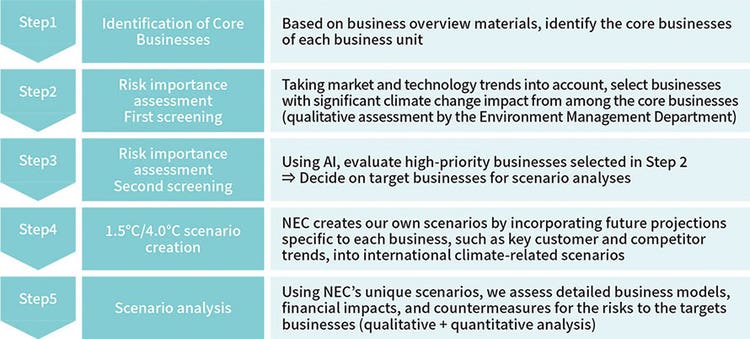
As a result of the steps above, we identified carbon pricing as a companywide risk, and the data center and telecom services businesses as business-specific risks.
Summary
In fiscal year 2025, the Company conducted a scenario analysis-based risk assessment across all its businesses.
By applying AI for the first time and screening by the Environment Management Department, NEC identified company-wide and business-specific climate-related risks that could reasonably be expected to impact the Company's outlook. The Environment Management Department led the assessment, and confirmed that the Company could continue and grow its business under any scenario by taking appropriate measures. From fiscal year 2026, we are challenging ourselves to conduct efficient and effective scenario analyses by maximizing the use of AI.
Objectives of Climate Change Measures
The Company is targeting carbon neutrality by fiscal year 2041. We have set targets for fiscal year 2041 and fiscal year 2035, and are taking action.
SBT Net-Zero and RE100
Scope 1, 2 and 3 Emissions
Thousand tons
Emissions
Greenhouse Gas Emissions (Scope 1, 2 and 3) *Market-based data for Scope 2
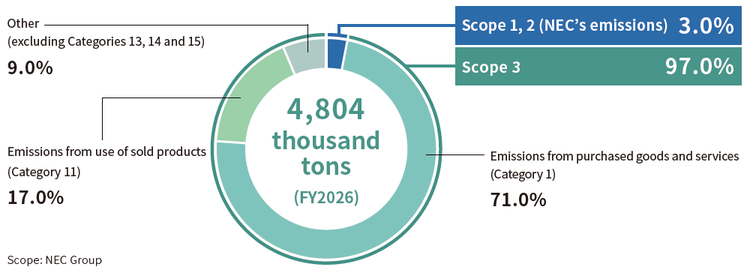
Calculation Method
We determine greenhouse gas emissions for the NEC Group on a financial consolidated basis. Scope 2 market-based calculations are based on the Act on Promotion of Global Warming Countermeasures, and location-based calculations are based on the country-specific emission factors in International Energy Agency (IEA) Emissions Factors 2025.
Scope 3 calculations are based on the GHG Protocol Scope 3 Standard.
Scope 1, 2, and 3 calculation results have all been verified by a third party.
Progress towards Our SBT Net-Zero Goal
The NEC Group has the goal of achieving carbon neutrality by 2040, which has been certified as a Net-Zero goal by SBTi. To achieve this goal, we aim to reduce Scope 1, Scope 2 and Scope 3 emissions by at least 63.6% each by fiscal year 2035 compared to fiscal year 2025.
To achieve our goals, for Scope 2 we are increasing the use of renewable energy that meets the RE100 standard. For Scope 3, we are engaging with our suppliers to reduce Category 1 emissions, which is the category with the highest emission volume. Furthermore, in order to reduce Category 11 emissions, we are working to improve the energy efficiency of our products and proposing the use of green data centers that use 100% renewable energy to our customers. However, Scope 3 emissions have increased as our business has expanded because the calculation of Scope 3 does not yet reflect the results of the above measures. To resolve this issue, we are currently reviewing our calculations to base them on primary data.
Third-party assurance
Scope of Environmental Data
CDP Corporate Questionnaire 2025 (NEC)
CDP Corporate Questionnaire 2026 (NEC)
Performance of Data Centers in Japan and Goals for Fiscal Year 2027
* Data for NEC data centers only.
* NEC Cloud IaaS uses 100% renewable energy.
Assets and Business Activities Exposed to Physical Risks
The Company operates data centers in 11 locations throughout Japan, including Kobe and Kanagawa. Data centers provide cloud services and data warehousing services to government agencies and companies, and are important facilities that operate multiple information systems. The operational continuity of data centers is critical to providing uninterrupted services to customers.
Meanwhile, in recent years, natural disasters have become more frequent in Japan. In 2019, a typhoon that brought record-breaking rainfall impacted a wide area of Japan. This rain caused major damage to lifelines, including power outages and broken water mains. River flooding caused widespread damage. Abnormal weather caused by climate change could increase the frequency of disasters, which could pose a risk to the continued operation of data centers.
With this in mind, the Company builds data centers in areas that are less susceptible to flooding and tsunamis to prevent water damage to facilities. Our data centers are equipped with emergency power sources with enough fuel to operate generators for at least 72 hours. This would allow information systems to continue to operate even in the event of a power outage. We have concluded priority fuel supply contracts with fuel suppliers to ensure that we receive priority fuel supplies in the event of an emergency.
In addition, to enable NEC to proactively respond to climate change in the future, we have decided to conduct annually the reevaluation of the natural disaster resilience of all data centers and load tests that involve start-up tests of emergency generators simulating actual power outages, and are taking action accordingly.
Internal Carbon Pricing
With the aim of improving energy efficiency and promoting the introduction of low-carbon facilities and equipment, we have set internal carbon pricing. This pricing allows us to convert the CO2 emission reductions that would result from a given capital investment into a monetary value, which we can then use as a reference when making investment decisions.
The aforementioned carbon pricing mechanism will drive our decarbonization activities going forward and reduce the risk associated with potential increases in carbon taxes and emissions trading in a decarbonized society of the future. The Company has set its internal carbon price at 3,000 yen/t-CO2.
Reflecting Climate Change in Executive Compensation
In fiscal year 2023, NEC determined key performance indicators (KPIs) and sustainability performance targets (SPTs) that reflect NEC's initiatives for "Environmental Action with a Particular Focus on Climate Change (Decarbonization)," and issued sustainability-linked bonds with maturities of five, seven, and ten years.
Failure to achieve all SPTs will require NEC to purchase emission rights (CO2 avoidance or reduction converted into credits or certificates) equivalent to 0.1% of the bond issuance amount prior to redemption, which will affect earnings. This will also significantly impact the Company's reputation, and will directly affect the evaluation of corporate officers, including directors. The impact is less than 5%.
The Chief Business Process Transformation Officer (CBXO) is responsible for the entire supply chain. The Company has formulated climate change guidelines with a long-term perspective to 2040, determined medium-term goals to 2030, and integrated short-term and medium-term goals that are reviewed annually. The CBXO is responsible for the NEC Group's medium- to long-term goals, and is working on functional reforms to promote environmental management.
Progress toward these goals factors into bonus assessment in the annual performance evaluation to reflect the significance of progress towards achieving the CO2 emission goals of the entire NEC Group. The impact is 10%.
Carbon Credits
In the Tokyo Cap-and-Trade Program (Tokyo Metropolitan Government Mandatory Total Reduction and Emissions Trading Scheme), we transferred the banked reduction amount at the Fuchu Plant to the Daito Tamachi Building and applied it to fulfillment of the obligation for that building. Note that this is an internal transfer under the scheme and is not an offset through procurement of external credits.
With a view to achieving carbon neutrality by 2040, NEC plans to use carbon credits in the future to neutralize residual emissions, but has not yet considered specific details.
Energy Efficiency & Conservation Mutual Audit Program
In collaboration with our group companies, we conduct the 'Energy Efficiency Mutual Audit Program' twice yearly. This initiative involves mutual visits among our facilities to assess and evaluate energy usage and energy-saving measures. Within each facility's energy efficiency activities, we utilize a "mandatory energy-saving action checklist" (commonly established across the group) to regularly monitor implementation status. The audit process involves identifying key focus areas based on this checklist, followed by on-site inspections and stakeholder interviews. Through this program, we verify compliance with mandatory energy-saving measures while also providing specific feedbacks for potential improvements. These efforts contribute to improving overall energy performance and further drive energy conservation and cost-saving initiatives across the group.