Approach to Supply Chain Management
In the course of doing business, the NEC Group endeavors to work not only internally, but also through collaboration and co-creation with suppliers while paying careful attention to its impacts on the environment and society as a whole, with the intention of gaining the trust of society and helping to create sustainable social value.
Governance
Supply Chain Management Framework
Within the NEC Group, NEC’s CBXO is responsible for sustainable procurement, and decisions are made by a committee chaired by the head of procurement in the Business Process Transformation Division.
At NEC and its major consolidated subsidiaries in Japan, individuals appointed as compliance promoters for purchasing-related laws and regulations ensure strict compliance within their respective companies and divisions.
In addition, meetings are held quarterly with procurement managers of major consolidated subsidiaries in Japan, during which participants share information regarding responses to changes in the sustainable procurement landscape, training programs for procurement personnel, and web-based training materials.
For consolidated subsidiaries outside Japan, NEC works with procurement managers at regional headquarters in Central and South America, Europe, and ASEAN and major local subsidiaries directly controlled by NEC Corporation to conduct periodic operational reviews in line with their annual activity policies and plans, and to promote sustainable procurement in accordance with the culture and business practices of each country, as well as with the basic policies and guidelines mandated by NEC Corporation.
In addition, NEC endeavors to enhance governance both in and outside Japan based on reports at these meetings.
Strategy
As part of its supply chain management strategy, NEC Group is addressing priority risks through collaboration and co-creation with suppliers.
Supply Chain Status
1. Critical Suppliers
The NEC Group designates suppliers that account for a high total value in procurement transactions, suppliers of rare products and suppliers that cannot be easily replaced as critical suppliers, and focuses on engaging in sustainable procurement measures. We are strengthening initiatives to address the sustainability risks we have identified across each region, sector, and procurement category.
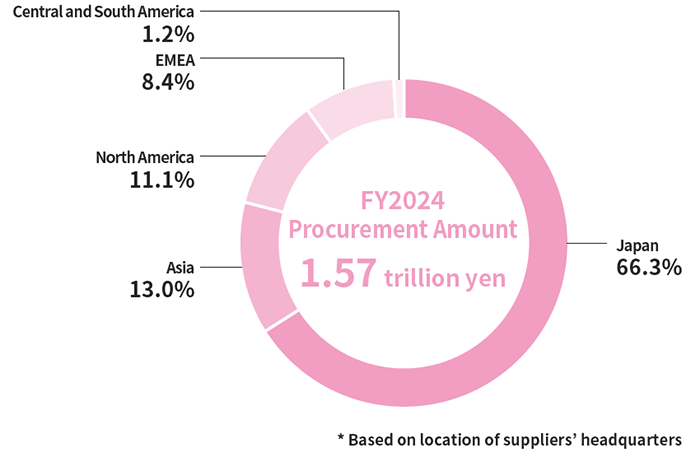
2. Procurement Amount by Region
Supply Chain Management Policy
The NEC Group formulated the NEC Group Procurement Policy based on its concept of management for sustainability and on the ISO 26000 and ISO 20400 international guidance standards for social responsibility and sustainable procurement. We are developing a policy for internal control pertaining to sustainable procurement, and rolling it out among suppliers. Additionally, regarding internal controls such as purchasing ethics, NEC has established the Basic Rules for Procurement and ensures that all employees comply with these rules. Furthermore, to strengthen internal controls, NEC has also devised concrete operational rules for its procurement processes and conducts regular training to ensure that the rules are disseminated among procurement-related personnel.
At the NEC Group, we promote activities in close collaboration with our suppliers, in accordance with procurement and security policies and guidelines, including consideration of human rights and the environment, while working to deepen mutual understanding. In addition to evaluating suppliers based on quality, cost and delivery (QCD), we also assess them from a sustainability perspective in an integrated manner, continuously striving to build stronger longterm partnerships.
(1) Human Rights
The NEC Group Procurement Policy clearly rejects slavery and human trafficking, and the Guidelines for Responsible Business Conduct in Supply Chains prohibit forced labour and child labour, while respecting workers’ right to organize. The policy and guidelines also require appropriate wages and management of work hours. Moreover, we perform human rights due diligence in accordance with OECD’s guidance process, identify and evaluate risks, and take steps to mitigate risks.
(2) The Environment
Our Guidelines for Responsible Business Conduct in Supply Chains call for a combined effort between the NEC Group and its suppliers to realize environmental management. At the same time, we have also set out the Environmental Specifications Pertaining to Procurement Restrictions for the Inclusion of Chemical Substances in Products, which require compliance with regulations on chemical substances in products in and outside Japan.
(3) Information Security
The NEC Group sets out security measures to be observed by workers we outsource to in Basic Rules for Customer-Related Work. We ensure thorough implementation by requiring these workers to formally pledge to abide by these requirements.
NEC intends to further strengthen initiatives that support customers’ procurement activities by leveraging these supply chain management activities as Client Zero. For details, please refer to Risk Management (Supplier Portal to Create Business Opportunities Using In-House Supply Chain Operations as Client Zero).
NEC Group Procurement Policy
Guidelines for Responsible Business Conduct in Supply Chains
Environmental Management (Development of Environmentally Friendly Products and Services)
Environmental Specifications Pertaining to Procurement Restrictions for the Inclusion of Chemical Substances in Products
Information Security and Cybersecurity
Priority Risks in Supply Chain Management
The NEC Group Procurement Policy and the Guidelines for Responsible Business Conduct in Supply Chains identify the following six priority risks: human rights and labour, occupational health and safety, environment, product quality and safety, information security, and fair trade and ethics. We require NEC Group suppliers, including Tier 2 suppliers and further upstream, to implement responsible business conduct.
Furthermore, we have identified “Promoting respect for human rights throughout the supply chain (Human Rights in Supply Chains)” as a materiality initiative for the period of NEC Group’s new Mid-term Management Plan, with regard to the human rights and labour risks listed above. The impact on the environment and society and the financial risks and opportunities are as follows.
Promoting respect for human rights throughout the supply chain (Human rights in the supply chain)
1. Impact on the Environment and Society
This includes human rights risks to workers in manufacturing processes at plants of suppliers outside Japan (including outsourced production), risk of long working hours in software development, and occupational health and safety risks during construction, maintenance and inspection.
2. Financial Risks and Opportunities
We are working in collaboration with suppliers, and while the likelihood of risk occurrence is low, reputational risk can be assumed if human rights violations are caused.
For information on our efforts related to the materiality “Visualizing and reducing the environmental negative impact of the value chain (Climate Change),” which addresses environmental risks in the supply chain, please see “Environmental Management (Supplier Engagement).”
Environmental Management (Supplier Engagement)
Risk Management
Risk Management Process in Supply Chain Management
With regard to priority risks in supply chain management, we conduct assessments based on document checks, internal analyses, and external research findings, map the relevant suppliers, and then carry out audits, corrective action requests, and follow-up on the status of improvements for high-risk suppliers. By running the PDCA cycle for these activities, we continue to engage in dialogue with our suppliers while working to ensure appropriate management across the supply chain.
1. Supply Chain Risk Assessment Results and Corrective Action
1.1. Document Checks
We continuously conduct document checks to assess the sustainability initiatives of NEC Group suppliers. In fiscal year 2026, we conducted the following checks.
companies in FY2026
(total for Tier 1 and Tier 2)
(1) Sustainable Procurement Self-assessment
We re-evaluate the progress of suppliers that scored low in past assessments, focusing on higher-risk areas. The suppliers assessed from fiscal year 2024 through fiscal year 2026 account for 70% of our consolidated procurement value. The assessment also covers details on the acceptance of foreign technical intern trainees and the handling of human rights issues by Tier 2 suppliers and further upstream.
In the fiscal year 2026 review, we received responses from 645 out of 734 Tier 1 suppliers approached. Each supplier’s efforts were evaluated on a five-point scale (A, B, C, D, Z) for each inspection theme—human rights, occupational health and safety, environment, fair trade, and other—based on their “score rate” and “critical points”1 evaluation criteria.
We issued feedback sheets to all suppliers that provided responses, indicating their score for each inspection theme and comparison to the average score for each procurement category, and shared the evaluation results with them. In the fiscal year 2026 survey, seven suppliers received a Z rating, indicating the existence of potential risks. Through supplier engagement, such as our understanding of the conditions and providing corrective action guidance, we will support suppliers that received the Z rating, with the aim of completing the correction of identified issues during the first half of fiscal year 2027.
For suppliers identified with high-risk items for correction in the fiscal year 2025 surveys, we provided corrective guidance and follow-up until correction was completed. Records are also kept of corrective plans and reports upon completion of corrective actions, which are used to improve our activities. No risks related to forced labour or child labour were identified in fiscal year 2025 either.
1. Critical points are questions that NEC has identified as potential risks, in light of the Guidelines for Responsible Business Conduct in Supply Chains, issued by NEC, and other regulations, if initiatives remain unaddressed.
categories
Furthermore, we carried out inspections of 11 Tier 2 suppliers with the cooperation of eight Tier 1 suppliers to enhance our ability to address upstream supply chain risks.
Regional headquarters and key local subsidiaries outside Japan conducted inspections of 21 suppliers on the themes of “human rights” and “occupational health and safety.”
(2) Survey on Decarbonization and Natural Capital Initiatives
For suppliers identified as having a significant environmental impact within the NEC Group’s supply chain, we confirm annual progress on CO2 reduction and efforts related to natural capital. The survey results are used to strengthen support and collaborative initiatives with suppliers on environmental issues, including decarbonization, as part of our efforts to reduce the negative environmental impact of the NEC Group’s businesses.
(3) Information Security Check Sheet
We implemented document checks for 1,736 companies through a dedicated inspection system. Information security is essential for the NEC Group, which is responsible for building information systems that are the foundation of society. In our supplier relationships, we place importance not only on technical capabilities but also on whether suppliers meet the Group’s standards for information security. Therefore, we have adopted a system in which we classify the information security levels of suppliers according to the status of their information security measures based on the results of the document checks, and select and entrust work to appropriate suppliers in line with NEC Group’s standards.
Information Security and Cybersecurity
Number of Suppliers That Responded to Document Checks/Number of Companies Targeted (Data Collection)
1.2 On-site Assessment
In the field of information security, we select suppliers for on-site assessments not only based on transaction volume, but also by comprehensively evaluating the importance and confidentiality of the information handled and the results of document checks. In fiscal year 2026, we conducted on-site assessments or remote inspections of 220 suppliers engaged in contracted development work. During these inspections, we verified that supplier employees comply with NEC’s information security instructions and requests through interviews, reviews of internal rules and procedures, and on-site observations, in order to prevent information security incidents. Although no major deficiencies were found, corrective guidance was provided to suppliers where minor improvements were deemed necessary in areas such as subcontractor management, labeling of confidential information, disposal and return of confidential materials, and countermeasures against cyberattacks. We share items that require improvement with our suppliers and follow up until improvement measures are implemented.
Number of Suppliers Whose Information Security Measures Were Inspected (Data Collection)
2. Supplier Engagement
2.1 Dissemination
NEC Group presents the NEC Group Procurement Policy, the Guidelines for Responsible Business Conduct in Supply Chains, and various other guidelines to its suppliers. We also hold various briefing sessions to explain the latest measures directly to suppliers and ensure their thorough dissemination.
(1) Environment
In July 2025, we held a decarbonization briefing session for suppliers to explain social trends, the decarbonization policy of NEC Group, and the requirements we place on suppliers.
Environmental Management (Supplier Engagement)
(2) Information Security
In fiscal year 2026, we held special briefing sessions for executives and study sessions for staff members in addition to our regular information security briefing sessions to ensure thorough dissemination of our information security measures in light of the current cybersecurity landscape.
2.2 Signing of Declarations by Suppliers
NEC requires suppliers to enter into master contracts and to sign declarations stating their commitment to the Guidelines for Responsible Business Conduct in Supply Chains. As an indicator for the materiality item “supply chain sustainability” during the period of the Mid-term Management Plan 2025, we worked toward a target of having suppliers who have signed declarations account for 75% of our total procurement amount by the end of fiscal year 2026. We also require all prospective suppliers to submit a declaration prior to commencing any business transactions.
As of the end of fiscal year 2026, we have obtained declarations from approximately 14,000 suppliers in and out of Japan, covering 88% of our consolidated procurement value.
2.3 Supplier Education and Awareness Training Activities
To support sustainability initiatives among its suppliers, NEC Group provides training opportunities and conducts awareness-raising activities on key topics such as human rights, labour, occupational health and safety, the environment, and information security.
(1) Human Rights
In fiscal year 2026, we held a Supplier Diversity Forum for key suppliers of NEC and its consolidated subsidiaries in Japan. This event was held with the aim of promoting diversity in the supply chain. A total of 148 supplier companies participated in this event, where our corporate officers presented on NEC’s Inclusion & Diversity initiatives. In the participant survey, 98% of respondents reported satisfaction with the session content, and 96% indicated they wished to apply the learnings to their own company’s initiatives.
NEC also provides information about seminars on “business and human rights” hosted by international organizations, government bodies, and industry associations on the supplier portal for NEC and its consolidated subsidiaries in Japan.
(2) Occupational Health and Safety
NEC and its consolidated subsidiaries in Japan are advancing health management initiatives in collaboration with our suppliers.
(3) Environment
NEC continues to hold briefing sessions and provide information related to climate change measures, and also offers educational materials that suppliers can use to train their employees on environmental topics.
Environmental Management (Supplier Engagement)
(4) Information Security
We hold Information Security Sessions for our suppliers, where we share the latest trends in information security and personal information protection, along with key considerations for business operations. These sessions also include continuous training on cybersecurity measures and awareness activities to prevent information security incidents.
2.4 Enhancing Information Security Management for Suppliers
The NEC Group requires suppliers to implement information security measures classified into seven categories: 1) contract management, 2) subcontracting management, 3) staff management, 4) information management, 5) implementation of technical safeguards, 6) security implementation, and 7) the execution of assessments. Especially regarding subcontracting management, the basic contract stipulates that suppliers may not subcontract to third parties without prior written approval from NEC.
In addition, the Group has clarified the framework for each project by obligating business partners to submit subcontractor confirmation documents. If subcontracting is unavoidable, the Group requires the same level of security for subcontractors that it requires for business partners in order to reduce the risk of information security incidents.
Since 2022, NEC Group has revised its information security standards based on NIST SP800-171, which requires the establishment of incident response capabilities, in order to strengthen its cybersecurity measures. Suppliers are required to prepare system security plans to confirm their compliance with NEC’s information security standards.
For aspects that are difficult for suppliers to handle alone, NEC hosts cybersecurity training sessions and discloses third-party evaluation results to critical suppliers with the aim of reducing attack risks and improving security levels to support their efforts in reducing risks.
Cybersecurity Management Report
3. Engagement with Employees
NEC and its consolidated subsidiaries conduct regular training programs for procurement personnel in accordance with internal procurement regulations. In addition, targeted training sessions on specific topics are held as needed to address new regulations or emerging risks, helping maintain proper operational execution.
3.1 Training for All Employees of NEC and Consolidated Subsidiaries
To raise awareness of sustainable procurement, NEC conducts web-based training on “business and human rights” and “environmental education” that informs employees about human rights and environmental risks in the supply chain and NEC Group’s sustainable procurement initiatives.
Respect for Human Rights (Human Rights Training and Awareness-Raising)
Environmental Management (Environmental Education and Awareness)
3.2 Training for Consolidated Subsidiaries Outside Japan
NEC provided web-based training on sustainable procurement to employees at key local subsidiaries outside Japan, with 212 participants completing the training. The web-based training focused on human rights (including the prohibition of modern slavery, child labour, and forced labour) and environmental impact, covering ESG concepts relevant to procurement, key due diligence requirements, and sustainability risks.
4. Participation in Stakeholder Engagement Initiatives
4.1 Participation in Activities with Other Companies
As a member of the Supply Chain Peer Learning Group of United Nations Global Compact Network Japan, we frequently discuss the ideal form of sustainable procurement with various members such as companies in different industries and NGOs, to define best practices in sustainable procurement and improve the quality of related initiatives. In fiscal year 2026, we helped lead the creation of the second edition of “Practical Manual on Human Rights Due Diligence — Responsible Business Conduct in the Human Rights Field,” a practical manual that offers support for corporate human rights due diligence, an achievement of the Supply Chain Peer Learning Group’s activities.
NEC is also a lead company in the task force under the JEITA CSR Committee, working to launch the Sustainable Procurement Partnership (SPP), which promotes responsible corporate behavior across the electrical and electronics industries. In fiscal year 2026, we held a Human Rights Due Diligence Practice Workshop and a Grievance Mechanism Development Practice Workshop for small and medium-sized enterprises as a small-scale trial called the SPP Trial to offer support to participating companies in establishing and implementing human rights due diligence frameworks and grievance mechanisms.
5. Supply Chain Due Diligence
We are advancing human rights and environmental due diligence in relation to NEC Group procurement transactions.
5.1 Due Diligence Steps in a Risk-based Approach
(1) Risk-based Approach
The Japanese government published the Guidelines on Respect for Human Rights in Responsible Supply Chains, and legal frameworks for preventing human rights abuses in supply chains have been updated abroad. With labour in supply chains being identified as a salient human rights issue, NEC Group has improved its efforts in human rights due diligence.
(2) Supply Chain Due Diligence
NEC is taking the following steps in accordance with OECD Due Diligence Guidance for Responsible Business Conduct.
Step 1
Collect and evaluate information on each risk from the perspectives of the ICT sector, region, and business characteristics, based on the ICT Sector Guide on Implementing the UN Guiding Principles on Business and Human Rights, the International Trade Union Confederation (ITUC)’s 2020 ITUC GLOBAL RIGHTS INDEX, other external research reports, and internal analysis of the NEC Group’s procurement structure.
Step 2
Combining the insights from Step 1 with the results of a human rights impact assessment conducted by BSR, an international NPO, we identify high-priority risks within key business domains. Examples include human rights risks to workers in manufacturing processes at plants of suppliers outside Japan (including outsourced production), human rights risks to foreign technical intern trainees in manufacturing processes at plants of suppliers in Japan, risk of long working hours in software development, and occupational health and safety risks during construction, maintenance and inspection.
Step 3
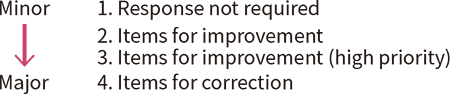
Map suppliers related to the above risks, evaluate the nature and scope of potential impacts, and conduct third-party audits by an external auditing firm, as well as second-party audits conducted by NEC, for selected suppliers (34 companies from fiscal year 2022 through fiscal year 2026). Incidents of nonconformance identified in these audits are evaluated and ranked according to the following four categories from the viewpoints of Japanese law and global standards. We provide feedback to suppliers and request corrective action.
5.2. Dialogue with external experts
Under Mid-Term Management Plan 2025, NEC identified Supply Chain Sustainability as a materiality and undertook initiatives to strengthen collaboration and co-creation with suppliers.
As one of these initiatives, in 2024 we held discussions with external experts to address challenges associated with human rights initiatives in our procurement activities.
Toward Further Development of Human Rights Initiatives in Procurement Activities
Audits related to human rights and occupational health and safety also include gender-related items, such as policies on sexual harassment, the presence of discrimination based on gender or dismissal on grounds of pregnancy, as well as appropriate health and safety measures for workers who are pregnant, postpartum, or breastfeeding. We require that high-risk corrective action items identified in audits generally be completed within six months. The results of on-site assessments are documented as formal audit records and used to follow up on the status of corrective actions and improvements.
In fiscal year 2026, we conducted third-party audits covering not only human rights and occupational health and safety risks but also environmental risks for certain suppliers. Nonconformances identified included failure to thoroughly communicate emergency response procedures for major earthquakes and similar events as well as deficiencies in labeling of liquid waste disposal areas. No nonconformances related to forced labour or child labour were identified.
For suppliers identified with high-risk items for correction in the fiscal year 2025 audit, we provided corrective guidance and follow-up until correction was completed.
Environmental Management (Environmental Due Diligence)
NEC Stories (Supply Chain Sustainability)
5.2. Dialogue with external experts
Under Mid-Term Management Plan 2025, NEC identified Supply Chain Sustainability as a materiality and undertook initiatives to strengthen collaboration and co-creation with suppliers.
As one of these initiatives, in 2024 we held discussions with external experts to address challenges associated with human rights initiatives in our procurement activities.
Toward Further Development of Human Rights Initiatives in Procurement Activities
Initiatives for Responsible Mineral Procurement
NEC Group seeks the understanding and cooperation of its suppliers for responsible mineral procurement based on its Responsible Mineral Procurement Policy. Using the Conflict Minerals Reporting Template (CMRT) and the Extended Minerals Reporting Template (EMRT),3 NEC conducts surveys of its suppliers to collect information on suppliers’ use of tin, tantalum, tungsten, gold (3TG), cobalt and mica, as well as the smelters in their supply chains. In fiscal year 2026, CMRT and EMRT surveys were conducted at suppliers representing approximately 60% of consolidated procurement amount. Based on the survey results, we are urging suppliers for which the use of smelters with high sustainability risks, such as those that contribute to conflict or involve forced labour or child labour, has been identified in the upstream supply chain to switch to alternative smelters.
NEC continues to participate in industry cooperation initiatives as a member of the Responsible Mineral Trade Working Group led by JEITA, including participation in the working group’s Education and PR Team, to help promote supplier understanding of responsible minerals sourcing.
2. CMRT and EMRT: Survey and reporting templates of the Responsible Minerals Initiative
NEC Group Responsible Mineral Procurement Policy
Responsible Procurement Management (Responsible Mineral Procurement)
Evaluation Prior to the Start of Procurement
Prior to initiating procurement, we assess the prospective company’s financial health, product and service quality and pricing, delivery timelines, and technical capabilities, as well as sustainability-related risks such as environmental impact and issues related to human rights, labour, and occupational health and safety. We also confirm the company’s intention to comply with the contents of the Guidelines for Responsible Business Conduct in Supply Chains and to sign the declaration form. Based on these factors, we make a comprehensive decision on whether to proceed with the new transaction.
External Ratings and Evaluations
1. Initiatives for the Environment
NEC has been recognized as a Supplier Engagement Leader, CDP’s highest Supplier Engagement Rating,3 for the sixth consecutive year. We believe this recognition reflects CDP’s positive evaluation of our various initiatives aimed at reducing CO2 emissions from our supply chain to achieve net zero.
3. The Supplier Engagement Rating is given by CDP based on an examination of a company’s initiatives for climate change and reduction of greenhouse gas emissions across the entire supply chain.
Third-party Assurance,External Ratings and Evaluations
Grievance Mechanism
NEC has established a multilingual whistleblowing system that suppliers can use to consult not only on compliance issues, but also on matters related to responsible procurement by the NEC Group more broadly, including human rights, labour, and occupational health and safety. To protect the privacy of whistleblowers, NEC allows anonymous reporting and has developed a system for responding to complaints and inquiries related to transactions. Additionally, every year, NEC sends a written Request for Cooperation toward Thorough Compliance and Responsible Procurement to our suppliers to request their cooperation in reporting potential compliance violations by NEC Group employees so that violations can be detected early and corrected, and to let them know NEC Group has a whistleblowing system available to provide consultation on responsible procurement in general.
In fiscal year 2026, a total of 20 reports regarding procurement issues were accepted via the NEC whistleblowing system. After verifying the relevant facts, all reports were dealt with appropriately. No reports related to forced labour or child labour were received.
From fiscal year 2023, NEC has been participating in an industry-wide initiative for a collective grievance mechanism (JaCER) and working to improve the effectiveness of the system in accordance with UNGP requirements.
Respect for Human Rights
Consultation of Procurement Compliance Issues for Social Responsibilities
Supplier Portal to Create Business Opportunities Using In-House Supply Chain Operations as Client Zero
We have launched a proof-of-concept for our Supplier Portal, which aims to improve sustainability across the supply chain and create corporate value. This was developed using AI, digital transformation (DX), and world-class expertise in sustainability management, with our own risk management process serving as Client Zero, in order to address such challenges as inefficient information flows between buyers and suppliers and the costs of managing complex questionnaires, and is being used to create new business opportunities. The portal integrates the management of self-assessment questionnaires (SAQs) for document checks related to sustainability, which were previously handled via email and Excel, into an online system, helping reduce man-hours for survey responses and data aggregation/analysis, as well as streamline and standardize operations. We aim to commercialize Supplier Portal during fiscal year 2027, then leverage NEC Group’s advanced security technologies and AI/DX expertise to build a supplier data distribution infrastructure that promotes secure data linkage and utilization between suppliers and companies, thereby enhancing the value of the entire supply chain.
Metrics and Targets
FY2031 KPIs
(Period: April 2026–March 2031)
M: Indicates the main non-financial targets related to materiality.
M: 100% completion rate for corrective actions regarding high-risk suppliers4
4. Since our corrective action efforts are a year-long process, the FY2031 KPI is the completion rate of corrective actions by the end of FY2031 for suppliers to whom we requested corrective actions in FY2030.
FY2027 Goals
- 100% completion rate for corrective actions regarding high-risk suppliers in fiscal year 2026
- Strengthen security measures to address sophisticated cyberattacks
FY2026 Goals and Results
1. FY2026 Goals
1.1. M: Suppliers Agreeing to Procurement Guidelines: Maintain at Least 75% (Materiality During the Mid-term Management Plan 2025 Period)
1.2. Eliminate Security-related Incidents Caused by Partner Companies Through Standard Inspections and Enhanced Cybersecurity Measures
(1) Strengthening cybersecurity measures
- Strengthen activities for compliance with information security standards based on NIST SP 800-171
- Visualize supply chain risk through expanded BitSight-based monitoring
- Improve the efficiency of cybersecurity measures using AI
(2) Strengthening information security for overseas suppliers
- Fully transition to the new information security standards for key suppliers in China
2. FY2026 Results
2.1. M: Percentage of Suppliers Agreeing to Procurement Guidelines: 88% (as of the end of fiscal year 2026)
2.2. Eliminate Security-related Incidents Caused by Partner Companies Through Standard Inspections and Enhanced Cybersecurity Measures
(1) Strengthening cybersecurity measures
- Fully transitioned to information security standards based on NIST SP 800-171
- Expanded BitSight-based monitoring to 1,800 companies
(2) Strengthening information security for overseas suppliers
- Conducted inspections of key suppliers in China based on the new information security standards and confirmed that countermeasures had been implemented